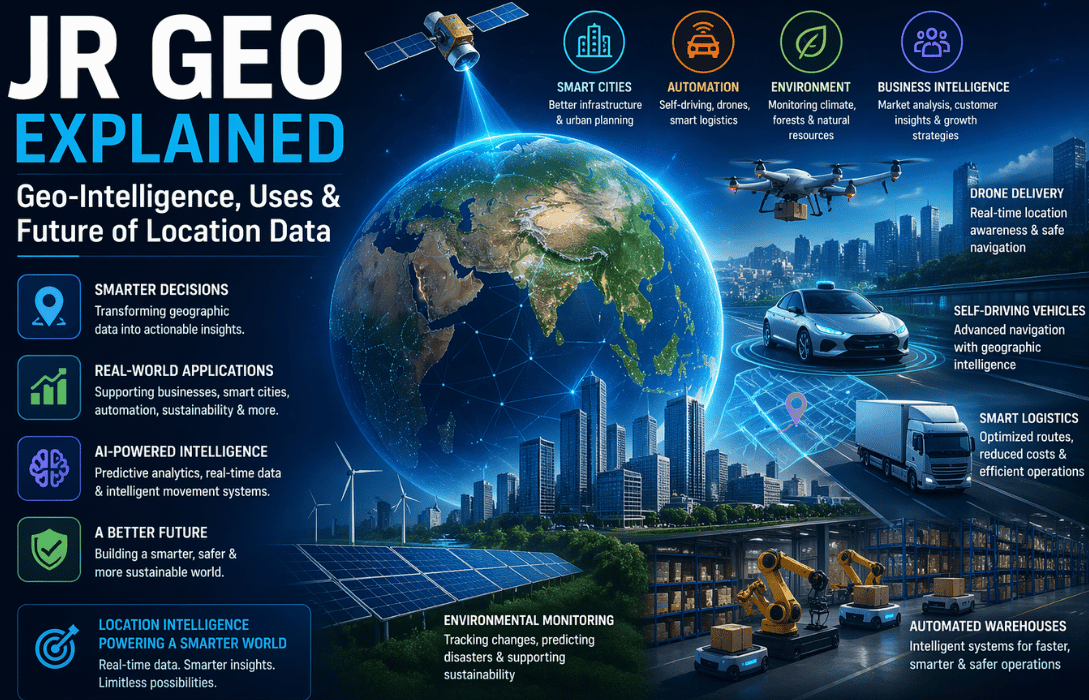
In today’s data-driven era, geography is no longer just about maps or physical locations. It has become a core layer of intelligence that influences how businesses operate, how governments plan, and how societies evolve.
This transformation is at the heart of JR GEO, a modern geo-intelligence framework that converts raw location data into actionable insight.
It represents the shift from traditional mapping to real-time, predictive and AI-driven geographic intelligence.
It connects satellite data, IoT systems, business analytics and machine learning into a unified ecosystem that supports smarter global decision-making.
The Origins: From Maps to Geo-Intelligence
The foundation of JR GEO can be traced back to early cartography and manual surveying. In those early stages, geographic understanding was static, slow and limited in accuracy. Maps were drawn by hand, updated infrequently, and difficult to scale.
The introduction of Geographic Information Systems (GIS) marked a turning point. For the first time, geographic data could be digitized, layered and analyzed. This shift laid the groundwork for modern geo-intelligence systems.
As technology advanced further, GPS, satellites and cloud computing transformed geography into a dynamic data system.
It emerged from this evolution as a next-generation framework that goes beyond mapping; it interprets movement, behavior, environment and infrastructure in real time.
What JR GEO Actually Is
It can be understood as a structured geo-intelligence ecosystem that integrates:
- Location-based data
- Spatial analytics
- Predictive AI models
- Real-time sensor inputs
- Business intelligence systems
Its core purpose is simple: transform geographic data into meaningful decisions.
Instead of just showing where things are, JR GEO answers:
- Why they are there
- What is happening there
- What will happen next
This makes it a strategic tool rather than just a technical system.
How JR GEO Works: The Intelligence Pipeline
It operates through a multi-layered structure:
Data Collection Layer
It gathers information from:
- Satellites
- GPS systems
- IoT sensors
- Mobile devices
- Traffic and environmental networks
This forms the raw geographic dataset.
Spatial Analysis Layer
Here, raw data is processed into patterns:
- Heatmaps
- Movement tracking
- Density clustering
- Route optimization
- Regional comparisons
This layer turns location data into structured insights.
Predictive Intelligence Layer (Geo-AI)
Machine learning models forecast:
- Traffic conditions
- Population movement
- Market demand shifts
- Environmental risks
- Infrastructure pressure points
This is where JR GEO becomes predictive instead of reactive.
Decision Layer
Insights are applied in real-world systems:
- Business expansion
- Urban planning
- Logistics optimization
- Disaster management
- Resource allocation
Visualization Layer
Data is displayed through:
- Interactive maps
- Dashboards
- 3D terrain models
- Real-time monitoring systems
This makes complex data understandable and actionable.
JR GEO in Business Intelligence
One of the most powerful applications of JR GEO lies in business strategy, where it enables companies to make highly informed, location-driven decisions.
By analyzing geographic patterns, businesses can identify high-demand regions, optimize supply chains, reduce delivery costs, detect regional performance differences and plan more effective market expansion strategies.
For instance, a company may discover that one region shows significantly higher customer retention compared to another, not through guesswork but through detailed geographic behavior analysis that reveals how location influences customer engagement and satisfaction.
Beyond performance optimization, It also strengthens risk management by highlighting fraud-prone regions, politically unstable zones and areas exposed to environmental risks.
This layered understanding of geography allows organizations to move away from speculative decision-making and instead rely on precise, data-backed insights that improve efficiency, reduce risk and enhance overall strategic outcomes.
JR GEO in Smart Cities and Infrastructure
Modern cities are becoming increasingly dependent on geo-intelligence, and JR GEO plays a key role in this transformation by supporting critical urban systems.
It helps optimize traffic flow, improve public transport efficiency, manage energy distribution systems, enhance waste management planning, and guide urban expansion strategies.
By analyzing population growth and real-time movement patterns, It enables cities to design infrastructure that reflects actual human behavior rather than assumptions or outdated models.
This data-driven approach results in smarter planning, reduced congestion, better resource allocation, and ultimately creates more efficient, sustainable and livable urban environments.
Environmental and Climate Applications
JR GEO plays a critical role in environmental monitoring and climate response by providing detailed insights into changing ecological and atmospheric conditions.
It helps track deforestation patterns, identify flood-prone areas, monitor temperature shifts, assess water resource usage, and evaluate agricultural conditions.
Governments and organizations rely on this information to predict natural disasters, strengthen emergency response systems, plan sustainable development initiatives and optimize the placement of renewable energy projects.
By enabling early detection and data-driven environmental planning, It becomes an essential tool in building long-term climate resilience and supporting global sustainability efforts.
Automation, AI, and Autonomous Systems
One of the fastest-growing areas of JR GEO is automation, where it plays a central role in enabling intelligent, location-aware systems.
It supports self-driving vehicles, drone delivery systems, smart logistics networks and automated warehouse operations by providing real-time geographic awareness and environmental context.
This allows machines to understand their surroundings more accurately and make safer, faster, and more efficient decisions.
When combined with artificial intelligence, It further enhances these systems by enabling predictive navigation and intelligent movement, allowing automated technologies to anticipate conditions and optimize routes before issues arise.
Consumer Behavior and Marketing Intelligence
JR GEO also transforms how businesses understand customer behavior by adding a strong geographic layer to analytics.
It reveals regional buying habits, location-based preferences, foot traffic patterns and deeper cultural and economic differences that influence consumer decisions.
With these insights, businesses can build hyper-local marketing strategies, tailoring products, pricing and advertisements to specific geographic audiences rather than applying a one-size-fits-all approach.
This localized precision leads to significantly higher customer engagement, improved conversion rates and stronger overall customer satisfaction, as brands align more closely with the needs and behaviors of each region.
Workforce Optimization and Operational Efficiency
Organizations use JR GEO to enhance workforce performance by applying geographic intelligence to everyday operations.
It helps optimize travel routes for field teams, reduce operational costs, improve delivery scheduling, and strengthen coordination across remote workforces.
By integrating real-time location data, companies can assign tasks more efficiently and minimize delays caused by inefficient routing or poor planning.
Additionally, JR GEO improves safety by identifying high-risk travel areas and optimizing emergency response times, allowing organizations to proactively manage risks while maintaining smoother and more efficient workforce operations overall. .
The Technology Behind JR GEO
JR GEO is powered by a combination of advanced technologies:
- Artificial Intelligence (AI)
- Machine Learning (ML)
- Big Data Analytics
- Cloud Computing
- IoT sensor networks
- Satellite imaging systems
Together, these technologies enable real-time global geographic intelligence.
Key Benefits of JR GEO
Across industries, JR GEO delivers:
- Faster decision-making
- Reduced operational costs
- Improved forecasting accuracy
- Stronger risk management
- Better resource allocation
- Real-time global visibility
It transforms guesswork into data-driven precision.
Challenges and Limitations
Despite its advantages, JR GEO faces challenges:
Data Privacy Concerns
Location data is sensitive and must be protected carefully.
Data Accuracy Issues
Incorrect or incomplete data can lead to flawed decisions.
Integration Complexity
Combining multiple systems and data sources is technically challenging.
These issues require strong governance, regulation, and ethical frameworks.
The Future of JR GEO
The future of JR GEO is deeply connected to global digital transformation.
We can expect:
Real-Time Global Intelligence
Instant insights into global movement, environment, and economics.
AI-Driven Predictions
Highly accurate forecasting of social, environmental, and business trends.
Autonomous Ecosystems
Fully automated systems powered by geo-intelligence networks.
Global Collaboration Systems
Shared geo-data platforms for governments, industries, and research institutions.
JR GEO will evolve from a tool into a foundational layer of global intelligence systems.
Long-Term Global Impact
In the long run, JR GEO will reshape:
- How cities are built
- How economies grow
- How disasters are managed
- How businesses compete
- How societies understand space and movement
It will become an invisible infrastructure powering decision-making across industries.
Conclusion
JR GEO represents the next stage in the evolution of geographic intelligence. It has transformed from basic mapping concepts into a powerful ecosystem that integrates AI, data analytics, and real-time environmental awareness.
Its impact spans business, climate science, urban planning, automation, and global development. As technology continues to evolve, It will become even more central to how decisions are made across the world.
In essence, It is not just about where things are—it is about understanding why they are there and what happens next.
FAQs
How is JR GEO different from traditional GIS or mapping tools?
JR GEO goes beyond static mapping by combining real-time data, AI, and predictive analytics. While GIS mainly focuses on storing and visualizing geographic data, It interprets patterns, predicts outcomes, and supports decision-making in areas like business, automation, and urban planning.
What data sources does JR GEO use?
It relies on multiple data streams such as satellite imagery, GPS data, IoT sensors, mobile location data, traffic systems and environmental monitoring tools. These combined inputs allow it to generate real-time geographic intelligence.
Can small businesses benefit from JR GEO?
Yes, small businesses can use JR GEO for targeted marketing, location-based customer insights, delivery optimization and identifying high-demand areas. It helps them compete with larger companies by making smarter, data-driven decisions.
How accurate are JR GEO predictions?
JR GEO predictions are highly accurate when supported by large, clean and real-time datasets. However, accuracy can vary depending on data quality, regional coverage and system integration.
Which industries benefit most from JR GEO?
Industries like logistics, transportation, retail, urban planning, agriculture, environmental science and smart city development benefit the most due to their heavy reliance on location-based decision-making.
How does JR GEO handle privacy concerns?
JR GEO systems typically use anonymized and aggregated data to protect individual privacy. Ethical frameworks and data protection policies are also implemented to ensure responsible use of location information.
What makes JR GEO a future technology?
JR GEO is considered a future technology because it combines AI, real-time data and geographic intelligence to predict and optimize complex systems. It is evolving into a core layer for smart cities, automation and global decision-making.
Is JR GEO difficult to implement in existing systems?
Implementation can be complex depending on the organization’s infrastructure. Companies need data integration systems, analytics tools and skilled personnel, but cloud platforms and APIs are making adoption easier over time.