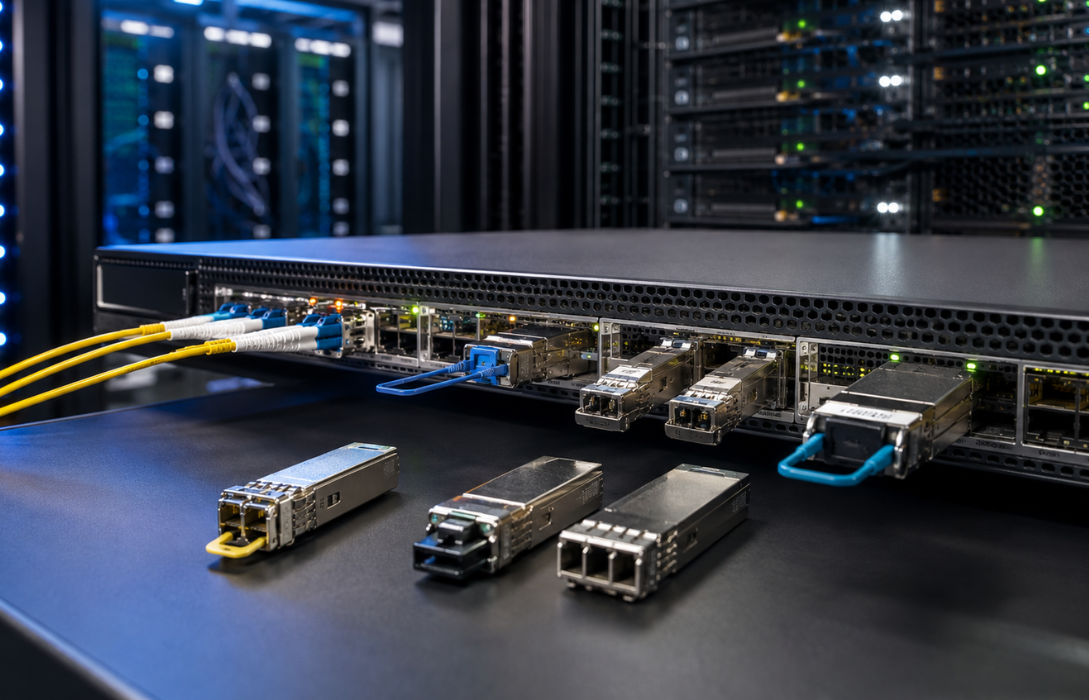
An optical transceiver may be tiny, but it has to agree with a surprisingly large number of things inside a network switch, router, server or transport platform. The MSA standard helps create that common ground by defining shared specifications for pluggable optical modules and their host interfaces.
The important point, however, is often missed: MSA does not mean that every transceiver works in every port. Instead, MSA specifications establish common mechanical, electrical and management characteristics so manufacturers can build compatible products without designing an entirely proprietary ecosystem.
What Is the MSA Standard?
MSA stands for Multi-Source Agreement. In optical networking, an MSA is an industry collaboration in which participating companies agree on technical specifications for a particular class of module, interface or form factor.
The goal is straightforward. If multiple manufacturers build modules according to the same specification, equipment designers have a common target rather than having to create a unique cage, connector, electrical interface and management system for every supplier.
That distinction is important because an MSA is not the same thing as a single universal standards organization. Different MSA groups can define different module families, while related organizations and specifications address electrical signaling, Ethernet, management and other aspects of the complete link.
What “Multi-Source Agreement” actually means
The word multi source describes the commercial and technical idea behind the agreement. A host manufacturer can design around a defined module interface, while multiple module manufacturers can develop products intended to fit that ecosystem.
The QSFP-DD specification, for example, defines mechanical and thermal requirements alongside electrical connectors, signals and power supplies for QSFP-DD family modules and cages. The specification describes itself as providing a common specification for systems manufacturers, integrators and module suppliers.
This approach gives the industry a shared engineering reference. It does not mean every implementation is identical internally; the optical engine, DSP, laser technology, firmware and manufacturing processes can differ substantially between suppliers.
MSA versus a formal industry standard
It is tempting to use “MSA standard” and “industry standard” interchangeably, but technically they can describe different things. An MSA is generally an agreement among participating companies around a specification, whereas standards such as IEEE 802.3 are developed through formal standards processes.
Optical modules frequently rely on several specifications at once. A transceiver can have an MSA defined mechanical form factor, an electrical interface associated with another specification and an Ethernet operating mode defined by IEEE. Understanding those layers prevents many compatibility mistakes.
What Does an MSA Specification Define?
The exact contents vary between MSA families, but an optical-module specification can cover much more than physical dimensions. Depending on the module family, the specification can address mechanical characteristics, electrical connections, signaling, power, thermal requirements and management behavior.
The QSFP-DD hardware specification is a useful modern example because it explicitly addresses electrical and optical connectors, electrical signals, power supplies, mechanical requirements, thermal requirements and the cage system.
Mechanical form factor and connector
The form factor determines how the module physically interfaces with the host. Dimensions, cage geometry, connector arrangements, latching mechanisms and related mechanical characteristics are important because a module that cannot physically mate with a host cannot establish a link regardless of its optical capabilities.
This is why SFP, QSFP28, QSFP-DD and OSFP should not be treated as interchangeable names. They represent different mechanical and electrical ecosystems, even when modules may support similar network speeds or applications.
Electrical interface and pinout
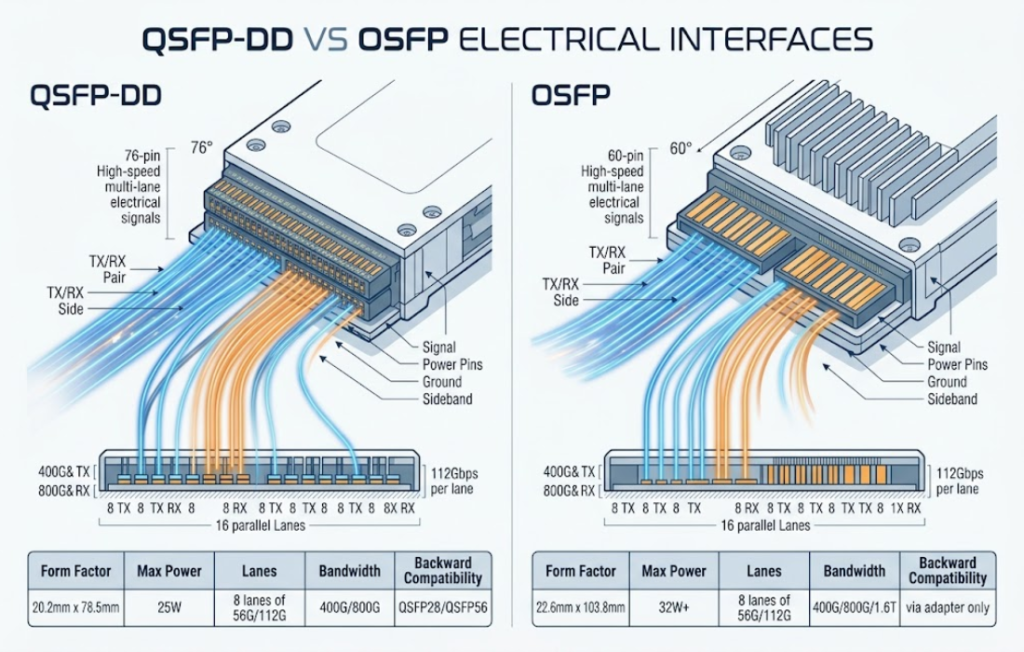
The electrical side is equally important. A transceiver converts between an electrical host interface and an optical or copper media interface, so the host and module must agree on how those electrical signals are presented.
Higher-speed modules increasingly use multiple electrical lanes. QSFP-DD, for example, is built around an eight-lane architecture, while OSFP specifications define their own electrical and mechanical characteristics. The OSFP MSA currently publishes specifications covering OSFP and OSFP-XD families.
Management and diagnostic interfaces
Modern transceivers are not simply “send and receive” devices. They contain management information that a host can read to identify the module and, depending on the specification, monitor parameters such as temperature, voltage, optical power and other operating conditions.
The SFF-8472 specification, for example, defines a memory map and digital management interface for monitoring and controlling SFP+ optical transceivers and similar modules.
For newer multi-lane modules, CMIS or Common Management Interface Specification, has become particularly important. OIF describes CMIS as providing a standardized mechanism for initializing and managing optical and copper modules while retaining room for custom functionality.
Thermal and power considerations
At higher data rates, thermal design becomes a major engineering constraint. A transceiver may fit mechanically and support the correct signaling rate yet still be unsuitable for a host platform if its power consumption or thermal characteristics exceed what that platform supports.
This is one reason newer form-factor specifications explicitly address thermal requirements. The QSFP-DD hardware specification, for instance, includes thermal requirements as part of its common module and cage specification.
Why Is the MSA Standard Important for Optical Transceivers?
The real value of an MSA standard is not the acronym printed on a product datasheet. Its value is the ecosystem it enables.
Without shared specifications, every switch vendor could create proprietary module dimensions, connectors, electrical interfaces and management methods. That would make module sourcing, equipment development, testing and upgrades substantially more complicated.
Multi vendor interoperability
A major benefit is the ability to develop optical modules around a common interface rather than a completely proprietary design. This creates the foundation for a multi vendor supply chain.
However, interoperability should be understood precisely. An MSA makes interoperability possible at the defined interface level; it does not automatically certify that every manufacturer’s module will operate correctly in every manufacturer’s switch.
That distinction becomes especially important when equipment vendors impose module qualification policies, firmware restrictions, supported transceiver lists or other implementation specific requirements.
Simplified equipment design
Host equipment manufacturers also benefit. Instead of engineering a unique physical interface for every possible transceiver supplier, they can design around established module specifications.
This common architecture allows switches and routers to support replaceable optical modules while module manufacturers concentrate on the optical, electrical, thermal and firmware implementation inside the agreed interface.
Greater supplier choice
For network operators, a mature multi-source ecosystem can reduce dependence on a single optical module supplier. Operators can evaluate products based on price, reach, power consumption, optical performance, warranty, availability and vendor support.
That flexibility becomes particularly valuable in large deployments where hundreds or thousands of transceivers may be required. Even then, procurement teams should validate compatibility with the exact host platform rather than treating “MSA compliant” as a blanket approval.
Faster technology evolution
MSA specifications also provide a mechanism for the industry to evolve module designs as bandwidth requirements change. The progression from lower rate SFP family modules toward multi-lane QSFP and newer high-density architectures illustrates how pluggable optics have evolved alongside network speeds.
The OSFP ecosystem is a current example. Its published specifications have progressed through multiple revisions, while the OSFP MSA has expanded the family to include OSFP-XD for greater lane density.
MSA Compliance Does Not Mean Universal Compatibility
This is the most important qualification to understand when buying an optical transceiver. An MSA compliant module can meet the relevant mechanical and interface specifications and still fail to establish a link in a particular system. Compatibility depends on several layers working together.
Form factor compatibility
The first question is physical. A QSFP28 module belongs in a compatible QSFP-family port, while an OSFP module requires an OSFP-compatible host interface. Even closely related form factors should not be assumed to be interchangeable. The OSFP MSA explicitly notes that OSFP and OSFP-XD are not mechanically or electrically cross-compatible.
Network protocol compatibility
The second question is whether the transceiver supports the networking technology required by the host.A module’s physical form factor does not tell you everything about its protocol. Ethernet, Fibre Channel, InfiniBand, coherent optical applications and other technologies can impose different electrical, optical or management requirements.
For example, “100G QSFP28” identifies a module family and general data-rate class, but the actual application still needs to match the host’s supported Ethernet standard, optical interface, wavelength, reach and other specifications.
Vendor coding and software restrictions
A third issue is vendor qualification. Some networking platforms identify the manufacturer, part number or coded information stored in the transceiver and may restrict unsupported modules.
This is why two modules that appear equivalent from a purely electrical and optical perspective can behave differently in the field. The MSA specification provides an interface framework; the host vendor can still impose operational policies above that framework.
Optical-link compatibility
Finally, the two ends of the optical link must make sense together. Wavelength, fiber type, connector, transmission distance, modulation, lane configuration and optical power budget can all matter.
A module can therefore be perfectly valid according to its MSA related specifications while being the wrong choice for a particular fiber plant. MSA compatibility and end to end optical compatibility are related, but they are not the same thing.
Common MSA Optical Transceiver Form Factors
The optical-transceiver market contains several major pluggable families, and each addresses different combinations of density, speed, thermal design and application requirements.
SFP- and SFP+
SFP- or Small Form-factor Pluggable, is one of the most widely recognized pluggable module families. SFP+ extended the concept for higher speed applications and became closely associated with 10Gb/s-class networking.
The management ecosystem around SFP-family modules includes specifications such as SFF-8472. The current SFF-8472 specification describes its management interface as an extension of the two-wire interface associated with the GBIC specification and SFP MSA.
SFP28
SFP28 retains the compact SFP-family mechanical concept while supporting higher speed host interfaces used for 25Gb/s class networking. Its popularity in server and data-center environments reflects the industry’s move toward greater bandwidth without abandoning the compact SFP form factor.
The important lesson is that the name alone is insufficient for procurement. The host port, Ethernet implementation, electrical signaling, optical specification and supported module list all need to be considered together.
QSFP+ and QSFP28
QSFP modules use multiple electrical lanes, allowing substantially more bandwidth than a traditional single lane SFP-family interface.
QSFP+ became associated with 40Gb/s-class applications, while QSFP28 became widely used for 100Gb/s class networking. Management of four-lane QSFP family modules is covered by SFF specifications such as SFF-8636, which SNIA currently lists as the management interface specification for four lane modules and cables.
QSFP-DD
QSFP-DD, meaning Quad Small Form-factor Pluggable Double Density, increases the number of high-speed electrical lanes compared with earlier QSFP generations.
The QSFP-DD MSA hardware specification covers QSFP-DD, QSFP-DD800 and QSFP-DD1600 module and cage families. Its published specification defines mechanical, electrical, optical-connector, power and thermal requirements and states that the family remains backward compatible with the classic QSFP+ form factor.
Backward compatibility here should not be interpreted as “every QSFP module works in every QSFP-DD application.” Compatibility depends on the particular host, module type, lane configuration, signaling mode and supported software.
OSFP
OSFP stands for Octal Small Form Factor Pluggable. It was developed for high speed networking and uses eight high-speed electrical lanes in its current architecture.
The OSFP MSA’s published FAQ describes OSFP as supporting up to 400Gb/s, 800Gb/s or 1.6Tb/s depending on the lane signaling generation. The organization also maintains a separate OSFP-XD specification with a different mechanical and electrical design.
CFP and XFP
CFP and XFP are earlier generations of pluggable optical module form factors that remain relevant when maintaining or understanding legacy networking infrastructure.
The CFP family has also been extended for specialized applications. For example, the OIF CFP2-DCO implementation agreement extends the CFP2 ecosystem for coherent applications and specifies mechanical, electrical, power, management and related characteristics.
How MSA Specifications Work With Other Standards

One of the biggest sources of confusion is assuming that an MSA specification defines the entire network protocol. It usually does not.
A working optical link is better understood as a stack of related specifications. The module form factor may come from an MSA, management behavior may come from SFF or CMIS and the Ethernet signaling or optical application may be defined elsewhere.
MSA and IEEE Ethernet standards
IEEE 802.3 defines Ethernet technologies and their physical-layer requirements. An optical module may therefore be designed to fit an MSA defined form factor while supporting an IEEE-defined Ethernet application.
This division of responsibility is useful. The MSA can establish how the module physically and electrically connects to the host, while an Ethernet specification defines what the communication system is expected to accomplish over the link.
MSA and SFF specifications
The SFF ecosystem provides several important specifications used by pluggable modules. SNIA currently lists SFF-8024 for module management reference codes and SFF-8636 for management of four-lane modules and cables.
This is why a product description may legitimately mention both an MSA form factor and an SFF management specification. They can describe different layers of the same module.
MSA and CMIS
CMIS has become increasingly important as high-speed modules have become more sophisticated.
OIF explains that CMIS work originally initiated by the QSFP-DD MSA was adopted by OIF in 2022 and is intended for pluggable and on board modules, including QSFP-DD, OSFP, QSFP and future module developments.
The current OIF work includes CMIS 5.3 and additional implementation agreements, demonstrating that module management continues to evolve alongside optical hardware.
MSA and Fibre Channel
Optical transceivers are also used beyond Ethernet. Fibre Channel equipment has its own requirements, meaning a module intended for a Fibre Channel environment should be evaluated against the relevant Fibre Channel specifications as well as its physical module requirements.
This reinforces a central point: the MSA describes part of the compatibility equation, not the entire equation.
How to Choose an MSA Compliant Optical Transceiver
Choosing an MSA-compliant optical transceiver should begin with the host rather than the module catalog. Find the exact switch, router, NIC, storage platform or transport device and determine which transceiver form factors and applications its port actually supports.
Start with the host port
Identify whether the host provides SFP+, SFP28, QSFP+, QSFP28, QSFP-DD, OSFP or another interface. Physical fit is the first filter, but it is only the beginning.
The host documentation should also tell you supported data rates, optical standards, maximum module power, supported management interfaces and whether third-party or coded modules are permitted.
Match speed and electrical interface
Next, match the module’s electrical requirements with the host. A module advertised as “400G” does not automatically mean that every 400G capable host can operate it.
At modern data rates, lane architecture and signaling matter. PAM4-based interfaces, lane counts, gearbox or DSP behavior and management requirements can all influence whether two devices work together.
Check optical reach and fiber type
Then evaluate the optical side. Determine whether the deployment uses single-mode or multimode fiber and compare the module’s wavelength, connector, transmission distance and optical budget with the installed fiber plant.
For example, a short reach multimode module and a long reach single mode module may use related host side technologies while serving completely different physical links. Choosing by data rate alone is therefore insufficient.
Verify management and vendor compatibility
Finally, check the host manufacturer’s compatibility documentation. Look for the exact supported transceiver family or part number where available.If a vendor specifies particular coding requirements or firmware support, treat those requirements as part of the compatibility test. An MSA compliant module can satisfy the underlying interface specification without being officially supported by every host vendor.
What Are the Benefits of MSA Compliant Transceivers?

The biggest advantage of MSA compliant optical transceivers is standardized interoperability at defined interfaces. That common foundation allows equipment and module manufacturers to participate in a broader ecosystem rather than creating completely isolated designs. For buyers, that can translate into greater supplier choice and easier technology evaluation. For equipment manufacturers, it can reduce the need to invent proprietary mechanical and electrical interfaces for every generation of pluggable optics.
MSA specifications also make technological progression more manageable. As optical networking moves toward higher lane rates, higher port density, more sophisticated diagnostics and increasingly complex thermal requirements, shared specifications provide a common engineering framework .The benefit is therefore not simply that an MSA module is “universal.” The more accurate description is that an MSA helps create a predictable foundation on which multi vendor optical networking can be built.
Conclusion
The MSA standard is best understood as part of the foundation that makes modern pluggable optical networking practical. By establishing common specifications for module families and interfaces, MSA groups allow multiple manufacturers to build products around shared technical requirements.
But MSA compliance should never be treated as a universal compatibility certificate. A successful optical link requires the module’s form factor, electrical interface, management system, optical characteristics, protocol, power requirements and host support to align.
That distinction becomes increasingly important as networking moves from SFP-family modules toward QSFP-DD, OSFP, higher lane rates and increasingly sophisticated management architectures. In other words, the value of MSA is not that it makes every transceiver interchangeable; its value is that it makes interoperability possible within a clearly defined technical framework.
FAQs
What is the MSA standard for optical transceivers?
MSA (Multi Source Agreement) defines common specifications for optical transceivers, helping manufacturers develop compatible modules for networking equipment.
Why is MSA important for optical transceivers?
MSA provides a common framework for mechanical, electrical, thermal, power and management requirements, supporting multi vendor optical networking.
Does MSA compliance guarantee transceiver compatibility?
No, MSA compliance does not guarantee compatibility with every switch or router; host specifications, firmware, coding, power and optical requirements also matter.
Can I use an MSA compliant transceiver with any switch?
No. Always check the switch manufacturer’s supported transceiver list, port type, data rate, optical standard and compatibility requirements.
What is the difference between SFP+ and QSFP28?
SFP+ is commonly used for 10Gb/s networking, while QSFP28 is widely used for 100Gb/s applications with multiple electrical lanes.
What is QSFP-DD in optical networking?
QSFP-DD is a high density pluggable form factor designed for high speed networking, featuring multiple electrical lanes and advanced power and thermal requirements.
What is OSFP in optical transceivers?
OSFP (Octal Small Form Factor Pluggable) is a high speed, multi-lane form factor designed for advanced 400G, 800G and higher bandwidth networking applications.
What is CMIS in optical transceivers?
CMIS (Common Management Interface Specification) provides standardized initialization, management, monitoring and control for modern optical and copper modules.