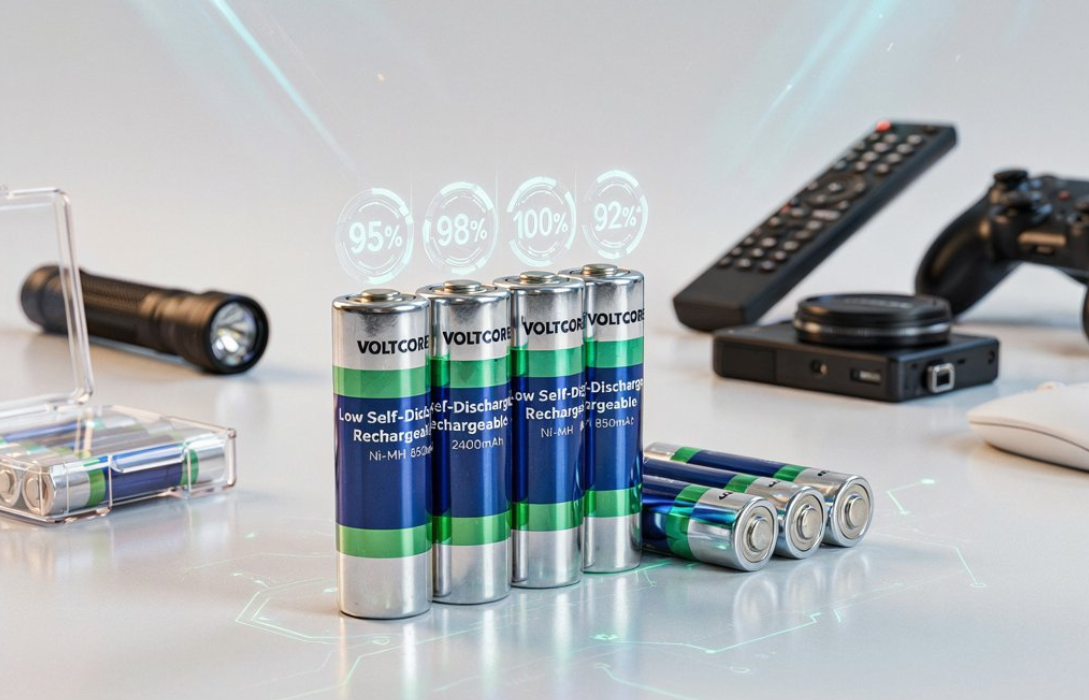
Rechargeable batteries have become a part of everyday life. They power everything from TV remotes and wireless keyboards to cameras, gaming controllers and emergency flashlights. Yet one common frustration remains: you charge a battery, put it away for a few months, and when you finally need it, it’s almost empty. That’s exactly the problem low self discharge technology was designed to solve.
In my experience, this is one of the most overlooked features when people shop for rechargeable batteries. Many buyers focus only on capacity (measured in mAh) and ignore how well a battery holds its charge over time. A battery with slightly lower capacity but excellent charge retention often performs better in real world situations than a high capacity battery that loses most of its energy while sitting unused.
If you’ve ever wondered what low self-discharge means, how these batteries work, whether they’re worth buying or which devices benefit the most, this guide will answer all those questions in simple language. We’ll also explore the science behind battery self discharge, compare different battery technologies and share practical tips to help you get the longest possible lifespan from your rechargeable batteries.
What Is Low Self Discharge?
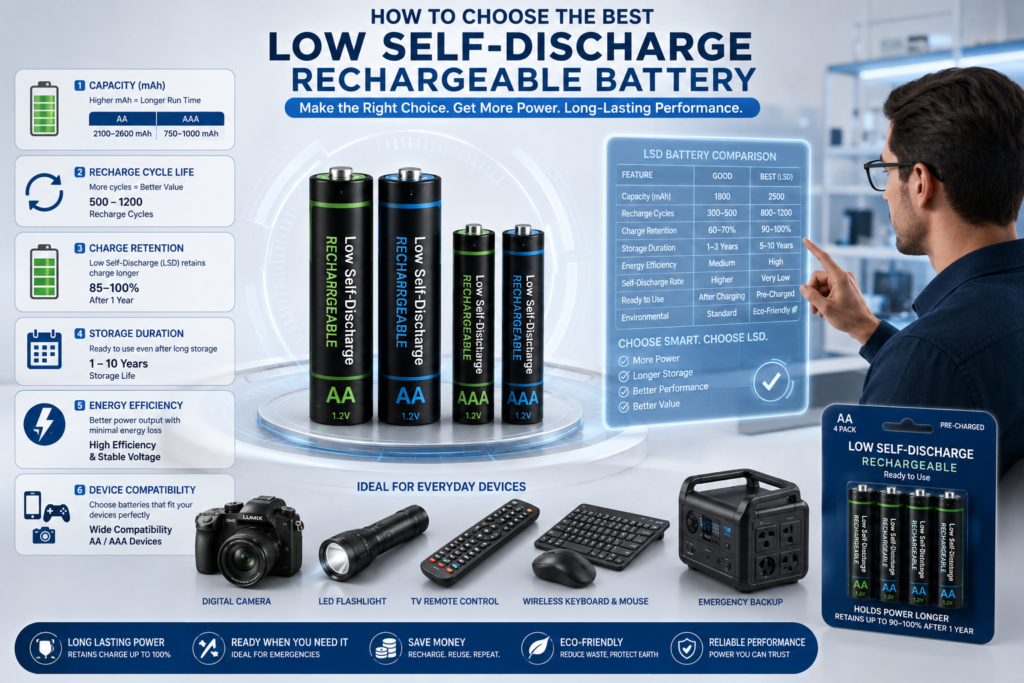
Low self discharge (often abbreviated as LSD) refers to a battery’s ability to retain most of its stored electrical energy even when it is not being used. Every rechargeable battery naturally loses some charge over time because of internal chemical reactions. This gradual loss is known as self discharge.
A low self-discharge battery is engineered to slow these unwanted chemical reactions. As a result, it remains charged for much longer than conventional rechargeable batteries. Depending on the battery chemistry and manufacturer, many low self discharge batteries can still retain around 70% to 85% of their charge after one year of storage under recommended conditions.
This may not sound dramatic at first, but imagine storing batteries for your emergency flashlight, smoke detector or digital camera. Instead of finding nearly empty batteries when you need them, they are still ready to perform.
Why Charge Retention Matters
People often confuse battery capacity with battery performance. They’re related, but they’re not the same thing.
Battery capacity tells you how much energy the battery can store. Charge retention tells you how much of that stored energy remains after days, weeks or even months of storage.
Think of it like filling two water bottles. One bottle has a tiny leak while the other is perfectly sealed. Both start with the same amount of water, but after several weeks, the leaking bottle contains much less. Batteries behave in a very similar way.
For devices that aren’t used every day, charge retention is often more important than maximum capacity. That’s why low self-discharge batteries have become popular for equipment such as:
- Digital cameras
- TV remotes
- Wireless mice
- Wireless keyboards
- Flashlights
- Medical devices
- Children’s toys
- Emergency radios
The History of Low Self Discharge Battery Technology
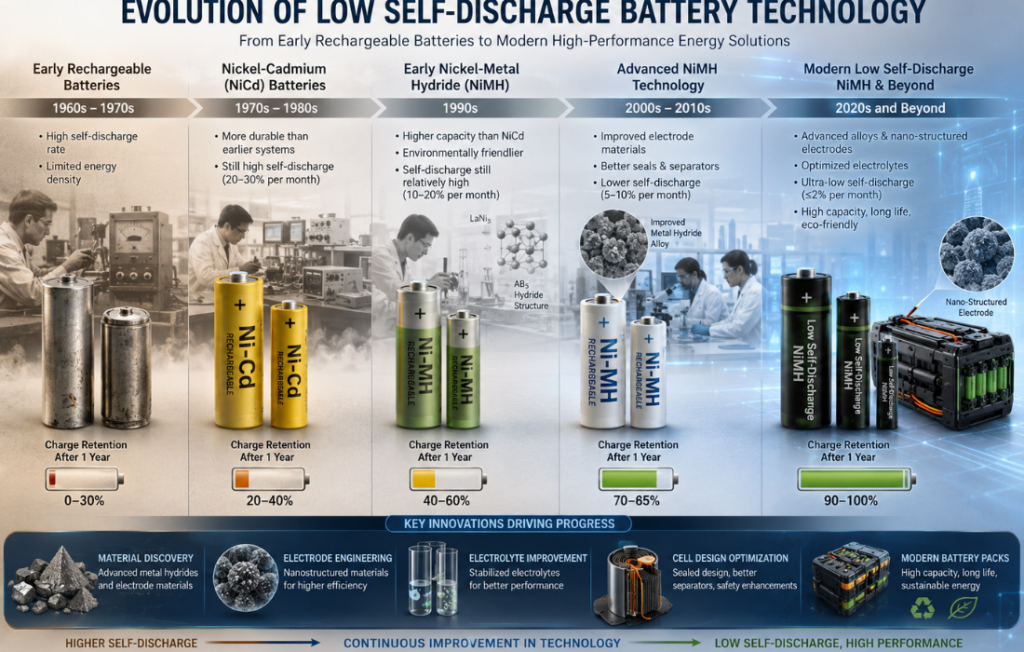
Rechargeable batteries have existed for well over a century, but early nickel metal hydride (NiMH) batteries had one major drawback. They could lose a significant portion of their stored energy within just a few weeks, even when sitting unused.
Manufacturers recognized this limitation and invested heavily in improving battery chemistry. During the early 2000s, engineers developed new separator materials, improved electrode designs and refined electrolyte formulations. These advances dramatically reduced unwanted internal reactions responsible for self discharge.
The result was a new generation of rechargeable batteries that arrived pre charged from the factory and retained their energy for much longer. Today, low self-discharge NiMH batteries are considered the standard choice for many household and professional applications.
Understanding Low Self-Discharge Batteries
To understand why these batteries perform so well, it helps to know what actually happens inside a rechargeable battery.
Every battery stores energy through chemical reactions. During charging, electrical energy is converted into chemical energy. During use, the process reverses, supplying electricity to your device.
Unfortunately, even when no device is connected, tiny chemical reactions continue inside the battery. These reactions slowly consume stored energy. This is the natural process known as self-discharge.
Low self discharge batteries reduce these internal reactions by using improved materials and manufacturing techniques. While no rechargeable battery completely stops self discharge, reducing it significantly makes a noticeable difference in everyday use.
How Self Discharge Happens
Inside every rechargeable battery are positive and negative electrodes separated by an electrolyte. Over time, microscopic chemical reactions occur between these components.
These reactions consume small amounts of stored energy without producing any useful electrical output.
Several factors influence how quickly this happens.
Temperature is perhaps the biggest factor. Batteries stored in hot environments lose charge much faster than those kept in cool, dry places.
Battery age also matters. Older batteries typically experience higher self discharge rates than newer ones because internal materials gradually degrade.
Charging habits can influence performance as well. Repeated overcharging or exposing batteries to unsuitable chargers may increase internal stress and accelerate capacity loss over time.
Battery Chemistry Explained
Different rechargeable battery technologies behave very differently.
Nickel-metal hydride (NiMH) batteries remain one of the most common choices for AA and AAA rechargeable batteries. Traditional NiMH batteries offered high capacity but suffered from rapid self-discharge.
Low self-discharge NiMH batteries improved this weakness dramatically. They provide an excellent balance between capacity, recharge cycles, environmental friendliness and long term storage.
Lithium ion batteries behave differently. They naturally have relatively low self-discharge rates, which is why smartphones, laptops and power tools can often remain unused for weeks without losing much charge.
Lead acid batteries, commonly used in vehicles and backup power systems, experience moderate self discharge and require occasional maintenance charging if stored for extended periods.
Each chemistry has strengths and weaknesses, making them suitable for different applications.
Low Self Discharge vs Traditional Rechargeable Batteries
At first glance, both batteries may look identical.
The difference becomes obvious after several months.
A traditional rechargeable NiMH battery might lose a large portion of its stored energy during storage. By comparison, a low self discharge version retains much more of its original charge, making it immediately usable.
Interestingly, traditional high capacity batteries sometimes advertise higher milliamp hour (mAh) ratings than low self discharge batteries.
Does that automatically make them better?
Not necessarily.
Imagine two batteries.
Battery A stores 2,700 mAh but loses nearly half its charge after several months.
Battery B stores 2,000 mAh but still retains most of its charge after the same period.
For devices used occasionally, Battery B often delivers better real-world performance despite having lower advertised capacity.
This is why photographers, emergency responders, and outdoor enthusiasts frequently choose low self discharge batteries over standard rechargeable models.
Understanding the Language Behind Low Self Discharge
Battery terminology can sometimes sound intimidating, but most of it becomes straightforward once the basic concepts are clear.
The phrase low self discharge combines three simple ideas.
“Low” describes the reduced rate of energy loss.
“Self” indicates that the battery loses energy on its own without powering any external device.
“Discharge” refers to the release of stored electrical energy.
Together, the phrase describes a rechargeable battery designed to lose very little energy during storage.
You’ll also encounter related terms such as charge retention, battery efficiency, cycle life, energy density and voltage stability. While these describe different aspects of battery performance, they all contribute to understanding how well a battery performs over its lifetime.
Common Terms You’ll Encounter
One term you’ll frequently see is cycle life. A recharge cycle means using a battery and then charging it again. Many quality low self discharge batteries are designed to survive hundreds or even thousands of recharge cycles before noticeable capacity loss occurs.
Another important specification is internal resistance. Lower internal resistance allows batteries to deliver power more efficiently, especially in high drain devices such as digital cameras.
You’ll also see pre charged or ready to use on battery packaging. These phrases indicate that the batteries leave the factory already charged and can often be used immediately without an initial charging session.
Multiple Meanings of “Battery” and “Discharge”
Interestingly, language itself adds another layer of complexity.
The word battery doesn’t always refer to an energy storage device. Depending on context, it may describe military artillery, a collection of equipment or even a legal offense involving physical contact.
Similarly, discharge has several meanings. In electronics, it describes the release of stored electrical energy. In medicine, it may refer to a patient’s release from a hospital. Environmental discussions might use it to describe water flowing into rivers or oceans.
Search engines rely heavily on context to determine which meaning users actually intend. In articles like this one, surrounding terms such as rechargeable batteries, voltage, capacity and charge retention make the intended meaning unmistakable.
Battery Classification
Low self discharge batteries belong to the broader family of rechargeable batteries, but not every rechargeable battery offers the same performance. Understanding where they fit within battery technology helps explain why they have become so popular.
The most common examples are low self discharge AA and AAA nickel metal hydride batteries used in household electronics. However, the same underlying principle of minimizing energy loss during storage influences many modern energy storage technologies.
These batteries also form part of larger systems. They are commonly found in battery packs, portable electronics, emergency lighting, wireless accessories and renewable energy solutions where dependable standby power is essential.
Inside each battery, several components work together to achieve low self discharge performance. The electrodes store and release energy, the electrolyte enables ion movement, the separator prevents internal short circuits and the casing protects the entire cell from physical damage and environmental exposure.
How Low Self Discharge Batteries Work
Low self discharge batteries may look like ordinary rechargeable batteries from the outside, but their internal design is where the real difference happens.
The main goal of this technology is simple: reduce unwanted chemical reactions that consume stored energy when the battery is sitting unused. Engineers achieve this through improvements in electrode materials, separators, electrolyte composition and manufacturing processes.
A battery is constantly balancing two competing forces. It needs to release energy efficiently when you need power, but it also needs to avoid losing energy when it is simply waiting. Low self-discharge technology improves that balance.
The Electrochemical Process Behind Charge Retention
Inside a rechargeable battery, energy is stored through chemical changes.
When you charge a battery, electrical energy pushes chemical reactions in one direction. When you use the battery, those reactions reverse and produce electrical current.
The challenge is that these chemical reactions do not completely stop when the battery is sitting idle. Small amounts of energy continue moving internally, creating natural self discharge.
Low self discharge batteries reduce this internal movement. Better electrode structures limit unwanted reactions, while improved separators help prevent chemical interactions that waste stored energy.
This is similar to improving insulation in a house. A poorly insulated home loses heat quickly, while a well insulated home keeps temperature stable for longer. A low self-discharge battery works in a similar way by “holding in” stored energy more effectively.
Why Low Self Discharge Batteries Last Longer
Longer lasting performance comes from controlling the factors that normally shorten battery life.
One major advantage is reduced chemical leakage during storage. Because less energy disappears while the battery is unused, fewer recharge cycles are wasted simply restoring lost power.
Another benefit is predictable performance. A normal rechargeable battery might be fully charged today but nearly empty months later. A low self discharge battery behaves more consistently, which is extremely useful for emergency equipment.
For example, imagine keeping rechargeable batteries for a camping flashlight. You may not touch them for six months. When a power outage happens or you head outdoors, the last thing you want is discovering that your batteries have quietly drained themselves.
Advantages of Low Self Discharge Batteries
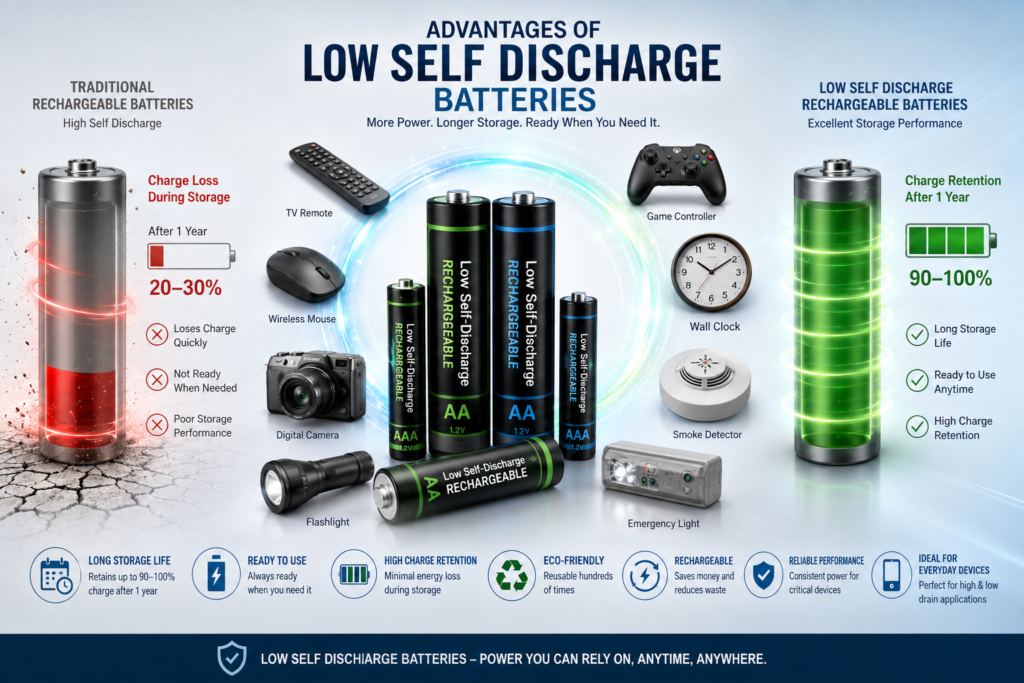
Low self discharge batteries have become popular because they solve one of the biggest complaints about traditional rechargeable batteries: poor storage performance.
They are not perfect for every situation, but for many everyday applications, their benefits are significant.
Long Shelf Life
The biggest advantage is their ability to maintain charge during storage.
Traditional rechargeable batteries often needed frequent charging even when they were not being used. Low self discharge models can remain ready for months, making them ideal for devices that spend most of their time sitting unused.
This is especially valuable for emergency equipment.
A smoke detector, emergency radio, flashlight or backup camera may only be needed occasionally. In these situations, battery reliability matters more than having the absolute highest capacity.
Better Reliability
Reliability is often more important than specifications printed on packaging.
A battery with impressive numbers means little if it fails when you need it.
Low self-discharge batteries are popular among photographers, travelers and professionals who depend on equipment working immediately. A photographer preparing for a wedding shoot, for example, cannot afford to discover that spare batteries stored in a camera bag have lost most of their charge.
The same principle applies to emergency kits. A rechargeable battery that remains ready after months of storage provides peace of mind.
Lower Long Term Cost
At first glance, low self discharge batteries can appear more expensive than disposable batteries.
However, the calculation changes when you consider recharge cycles.
A quality rechargeable battery can replace hundreds of disposable batteries over its lifetime. Even after considering the cost of a charger and electricity, rechargeable options often become cheaper for frequently used devices.
The financial benefit is especially noticeable in homes with many battery powered devices.
Environmental Benefits
Disposable batteries create significant waste because they are discarded after a single use.
Rechargeable batteries reduce the number of batteries entering waste streams. While rechargeable batteries still require responsible recycling at the end of their life, using one battery hundreds of times is generally more resource-efficient than repeatedly buying disposable alternatives.
Low self discharge technology improves this advantage because batteries remain useful for longer periods and waste less energy during storage.
Disadvantages of Low Self-Discharge Batteries
Although low self discharge batteries are excellent for many applications, they are not a universal solution.
Understanding their limitations helps you choose the right battery technology.
Higher Initial Price
The first drawback most people notice is cost.
A pack of low self discharge rechargeable batteries usually costs more upfront than disposable alkaline batteries.
For someone who rarely uses batteries, the savings may take longer to appear.
However, for devices used regularly, the investment usually makes more sense because the batteries can be recharged many times.
Charging Considerations
Rechargeable batteries require a compatible charger.
Using a poor quality charger or an unsuitable charging method can reduce battery lifespan. Modern smart chargers are designed to monitor charging conditions and prevent problems such as overheating or overcharging.
A good charger is not just an accessory; it is part of maintaining battery health.
Lower Capacity Compared With Some Alternatives
Some traditional rechargeable batteries advertise higher capacity ratings.
For example, a standard NiMH battery might offer a higher mAh number than a low self discharge model.
However, capacity alone does not determine usefulness.
A high-capacity battery that loses significant energy while stored may perform worse than a slightly lower-capacity battery that remains charged for months.
Practical Applications of Low Self Discharge Batteries
Low self discharge technology works best in devices where batteries are used occasionally or need dependable standby performance.
Household Electronics
Many everyday devices benefit from low self-discharge batteries.
Remote controls, clocks, wireless keyboards, computer mice and toys often sit unused for long periods. A rechargeable battery that maintains its charge reduces the frustration of frequent battery replacement.
For households trying to reduce disposable battery waste, these devices are a natural starting point.
Photography Equipment
Photography is one area where battery reliability matters greatly.
External flashes, wireless triggers, cameras and accessories often require batteries that can deliver consistent power.
Many photographers prefer low self discharge NiMH batteries because they combine reliable storage with strong performance during high power demands.
A photographer preparing for an important event does not want to spend the first hour charging batteries that were supposed to be ready.
Medical and Emergency Devices
Battery failure is inconvenient in some situations and dangerous in others.
Emergency lighting, portable medical equipment, backup communication devices and safety equipment benefit from batteries that maintain charge during standby periods.
The key advantage is confidence. When equipment is rarely used but urgently needed, stored energy retention becomes extremely important.
Gaming Accessories
Wireless controllers, VR accessories and gaming peripherals can consume significant power.
Low self discharge rechargeable batteries provide a practical alternative to constantly buying disposable batteries.
Gamers who play frequently also benefit from the ability to recharge batteries repeatedly instead of purchasing replacements.
Solar Lighting Systems
Many outdoor solar lights use rechargeable batteries.
Because these lights charge during the day and operate at night, battery storage efficiency affects performance. Low self discharge batteries can help maintain better energy availability, especially during periods of limited sunlight.
However, not every solar light is designed for every battery chemistry, so compatibility should always be checked before replacing batteries.
How to Choose the Best Low Self Discharg
Choosing the right battery depends on your device, usage pattern and expectations.
The “best” battery is not always the one with the highest capacity number. It is the one that matches your actual needs.
Consider Battery Capacity (mAh)
Milliamp-hour (mAh) measures how much electrical energy a battery can store.
Higher capacity generally means longer runtime before recharging.
However, capacity should be considered alongside self discharge rate. For occasional-use devices, charge retention may matter more than maximum capacity.
Look at Recharge Cycle Life
Cycle life describes how many charging and discharging cycles a battery can handle before performance declines.
A battery with a long cycle life provides better value over time.
Quality low self discharge NiMH batteries are often designed for hundreds of recharge cycles, with premium models reaching much higher numbers depending on usage conditions.
Consider Brand Reputation
Battery manufacturing quality varies significantly.
Established manufacturers typically invest more in quality control, testing and consistent chemistry.
Well-known low self discharge battery brands include Panasonic Eneloop, GP ReCyko, Energizer Recharge and Duracell Rechargeable. However, specifications and performance can change between models, so checking the exact product details is important.
Match the Battery to Your Device
Different devices have different energy requirements.
A TV remote may work perfectly with almost any rechargeable battery. A digital camera flash, however, requires batteries capable of delivering higher current quickly. Understanding your device’s power demand helps prevent disappointment.
Maintenance Guide for Longer Battery Life
Even the best rechargeable batteries benefit from proper care.Small habits can significantly extend battery lifespan.
Store Batteries Properly
Temperature has a major effect on battery health.
Avoid storing batteries in extremely hot locations such as cars, direct sunlight or near heating equipment. Cool, dry storage generally provides better long term performance. Keeping batteries organized and protected from metal objects also prevents accidental short circuit.
Use the Right Charger
A quality charger can make a major difference.
Smart chargers monitor charging progress and adjust current levels automatically. They help prevent overheating and unnecessary stress on battery cells.
Cheap chargers may not provide the same level of protection.
Avoid Complete Over Discharge
Allowing rechargeable batteries to drain completely too often can reduce lifespan.
For everyday devices, recharge the battery when performance starts declining rather than waiting until the device stops working completely.
Common Myths About Low Self Discharge Batteries
Myth: Low Self Discharge Batteries Never Lose Charge
They do lose charge, just much more slowly.
No rechargeable battery completely eliminates self-discharge. The technology simply reduces the rate of energy loss.
Myth: Higher mAh Always Means Better Battery
Capacity is only one measurement.
A battery’s real world performance depends on capacity, discharge rate, cycle life, storage ability and device requirements.
A balanced battery often beats a battery with a higher number on the label.
Myth: They Are Always Better Than Lithium Ion Batteries
Different technologies serve different purposes.
Lithium ion batteries offer advantages in smartphones, laptops and electric vehicles because of their high energy density and lightweight design.
Low self discharge NiMH batteries remain excellent for AA and AAA applications where safety, reliability and long shelf life are priorities.
Future of Low Self Discharge Technology
Battery technology continues evolving rapidly.
Researchers are exploring improved electrode materials, solid state designs and advanced energy storage systems that could further reduce energy loss while increasing capacity.
Demand for efficient storage is also growing because renewable energy systems depend heavily on reliable batteries. Although low self-discharge technology is most commonly associated with small rechargeable cells today, the underlying goal of storing energy efficiently over time is becoming increasingly important across the entire energy industry.
The future will likely involve multiple battery technologies working together rather than one universal replacement.
Conclusion: Are Low Self-Discharge Batteries the Future of Rechargeable Power?
Low self discharge technology solved one of the biggest weaknesses of rechargeable batteries: losing energy while sitting unused.
For years, people avoided rechargeable batteries because they remembered the frustration of charging them, storing them and discovering they were empty when needed. Modern low self discharge batteries changed that experience by making rechargeable power far more practical.
The biggest lesson is that battery performance is not just about capacity. A battery that stores slightly less energy but keeps that energy for months can be far more useful than a higher capacity option that slowly drains itself.
For household electronics, emergency equipment, photography gear and many everyday applications, low self discharge batteries offer an excellent combination of reliability, convenience and reduced waste.
Battery technology will continue improving, but the basic idea behind low self discharge remains important: storing energy is only useful if that energy is still available when you actually need it.
FAQs
What is a low self discharge battery?
A low self discharge battery is a rechargeable battery that loses its stored energy very slowly when not in use. It is designed to maintain its charge for a longer time compared to traditional rechargeable batteries.
How long can a low self discharge battery hold its charge?
The charge retention depends on the battery type, manufacturer and storage conditions. Many modern LSD NiMH batteries can retain around 70 to 85% of their charge after one year.
Are low self discharge batteries worth buying?
Yes, they are worth buying for devices that are used occasionally. They are useful for flashlights, cameras, emergency equipment and other electronics that need long lasting charge.
Are Eneloop batteries low self-discharge?
Yes, Panasonic Eneloop batteries are well known low self-discharge NiMH rechargeable batteries. They are popular because they maintain their charge for a long time.
What is the difference between low self discharge batteries and normal rechargeable batteries?
Low self discharge batteries lose charge much slower during storage. Normal rechargeable batteries lose energy faster when they are not being used.
Can low self discharge batteries replace alkaline batteries?
Yes, they can replace alkaline batteries in many devices. However, the battery voltage, size and device compatibility should be checked before use.
Which battery chemistry has the lowest self-discharge?
Lithium-ion batteries generally have very low self-discharge rates. Among AA and AAA batteries, LSD NiMH batteries are commonly used for their good performance and storage life.
Can low self-discharge batteries be used in solar lights?
Yes, they can be used in many solar lights if they match the required battery size, voltage and chemistry of the device.
How should low self discharge batteries be stored?
They should be stored in a cool and dry place away from heat and direct sunlight. A battery case can help protect them from damage.