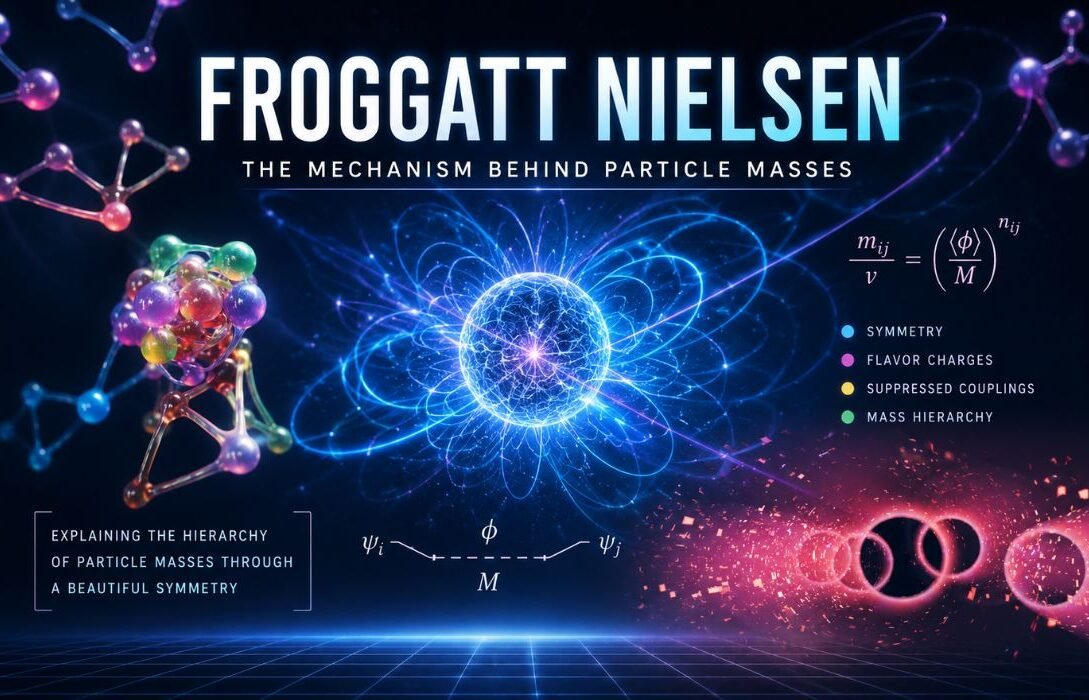
The Froggatt Nielsen mechanism is an important theoretical idea in modern particle physics that helps explain one of the biggest mysteries of the Standard Model: why elementary particles have such different masses. Some particles, like electrons, have very small masses while others such as top quarks, are much heavier. Scientists have been searching for explanations behind these differences and the Froggatt Nielsen mechanism provides a possible solution.
Proposed by physicists Holger Bech Nielsen and Charles Froggatt in 1979, this mechanism introduces the idea that hidden symmetries and new fields may control how particles gain mass. It suggests that particle interactions are influenced by an additional symmetry that is broken at a high energy scale, creating the different mass patterns observed in nature.
The Froggatt Nielsen mechanism remains an active area of research because it connects particle physics, symmetry theory and possible discoveries beyond the Standard Model.
History of the Froggatt Nielsen Mechanism
The Froggatt Nielsen mechanism was proposed by Charles Froggatt and Holger Bech Nielsen in 1979 to explain why elementary particles have different masses and interaction strengths.
The mechanism introduced an additional flavor symmetry that can distinguish between different particle generations. When this symmetry breaks, it can create different interaction strengths and help explain the observed hierarchy of fermion masses. This idea has made the mechanism useful for studying flavor structure and physics beyond the Standard Model.
What Is the Froggatt Nielsen Mechanism?
The Froggatt Nielsen mechanism is a theoretical framework designed to explain the hierarchy of fermion masses and mixing patterns. In simple terms, it describes why some fundamental particles are much heavier or lighter than others.
The Standard Model explains how particles interact but it does not fully explain why particles have their specific masses. The Froggatt Nielsen mechanism attempts to answer this question by introducing an additional symmetry called a flavor symmetry. According to this theory:
Different particles have different charges under a new symmetry. This symmetry is broken through a new field called the flavon field. The breaking of this symmetry creates different levels of interaction strength.
These differences result in the wide range of particle masses observed today. The mechanism uses mathematical relationships to show how small differences in particle interactions can produce large differences in mass.
Why Was the Froggatt Nielsen Mechanism Proposed?
The main motivation behind the Froggatt Nielsen mechanism was the unexplained pattern of particle masses in the Standard Model. Scientists observed that:
The top quark is extremely heavy compared to other quarks. The electron has a very small mass. Neutrino masses are incredibly tiny. Quarks and leptons show specific mixing patterns.
The Standard Model provides accurate predictions for particle behavior but does not explain why these mass differences exist. The Froggatt Nielsen mechanism was introduced as a possible explanation for this problem. By adding a new symmetry structure, the theory creates a natural way to generate different particle masses without requiring random values.
How Does the Froggatt Nielsen Mechanism Work?
The Role of Flavor Symmetry
A key concept in the Froggatt Nielsen mechanism is flavor symmetry. This symmetry treats different generations of particles differently. For example, the three generations of quarks and leptons have similar properties but very different masses. Flavor symmetry provides a possible reason for these differences.
When the symmetry exists, certain particle interactions are restricted. After the symmetry breaks, these restrictions are removed but the effects remain in the form of different particle masses.
The Flavon Field
The flavon field is another important part of this mechanism. A flavon is a hypothetical particle field that obtains a special value called a vacuum expectation value (VEV). This process breaks the flavor symmetry. The strength of particle interactions depends on how much the symmetry is broken. A common relationship is represented by:
Mass strength ≈ (flavon value / high energy scale)ⁿ
The value of “n” depends on the charge assigned to each particle. This creates different mass levels among particles.
Connection With the Standard Model
The Froggatt Nielsen mechanism does not replace the Standard Model. Instead, it extends it by adding additional ideas that explain unanswered questions. It is often studied alongside:
- Grand Unified Theories (GUTs)
- Supersymmetry models
- Axion like particle theories
- Neutrino physics
These connections make the Froggatt Nielsen Mechanism valuable in theoretical physics research. They help scientists explore particle masses, flavor patterns and possible theories beyond the Standard Model.
Applications of the Froggatt Nielsen Mechanism
The Froggatt Nielsen Mechanism has been applied in various areas of particle physics research. It helps scientists study particle masses, flavor patterns and theories beyond the Standard Model.
Explaining Fermion Mass Hierarchies
One of its main uses is explaining the hierarchy of fermion masses and why different particles have different mass levels in a specific pattern. For example:
The top quark has a mass close to the scale of the Higgs field. The electron is much lighter. Other quarks and leptons fall between these extremes. The mechanism suggests that these differences come from different flavor charges and symmetry breaking effects.
Understanding Quark Mixing
Another important application is explaining the Cabibbo Kobayashi Maskawa (CKM) matrix, which describes how quarks change between different types. The Froggatt Nielsen mechanism can create patterns that match the observed mixing behavior of quarks.
Studying Neutrino Masses
Neutrinos have extremely small masses compared to other particles. Scientists use the Froggatt Nielsen mechanism to explore possible reasons behind this unusual feature. It can be combined with neutrino theories, including the seesaw mechanism, to create models that explain tiny neutrino masses.
Although the Froggatt Nielsen Mechanism is a theoretical concept, it plays an important role in modern physics research. It helps scientists explore particle properties, mass patterns and new ideas beyond the Standard Model.
Particle Collider Experiments
Large research facilities such as the Large Hadron Collider (LHC) study particle behavior at extremely high energies. Experiments at the LHC help scientists test theories related to physics beyond the Standard Model. Researchers use experimental results from particle collisions to evaluate whether ideas like flavor symmetry could exist in nature.
Dark Matter and New Physics Studies
Some versions of Froggatt Nielsen models connect with theories involving new particles. Scientists investigate whether hidden symmetries could provide clues about unexplained phenomena such as dark matter.
Axion Like Particle Research
Modern studies also explore connections between the Froggatt Nielsen mechanism and axion-like particles (ALPs). These hypothetical particles are studied because they may provide information about symmetry breaking and new physics.
Advantages of the Froggatt Nielsen Mechanism
The Froggatt Nielsen Mechanism has several important strengths that make it valuable in particle physics research. It provides possible explanations for particle masses, flavor patterns and physics beyond the Standard Model.
It provides a natural explanation for particle mass differences. It connects different areas of theoretical physics. It reduces the need for unexplained numerical values. It creates testable predictions for future experiments. It helps researchers explore physics beyond the Standard Model.
Because of these advantages, the Froggatt Nielsen Mechanism remains an important topic in particle physics. It continues to help researchers understand particle properties and explore new theories beyond the Standard Model.
Challenges and Limitations
Despite its usefulness, the Froggatt Nielsen Mechanism also has some challenges. Researchers continue to study its limitations, including experimental verification and the search for evidence of new particles or hidden symmetries. Some limitations include:
- The flavon field has not been experimentally discovered.
- Many possible versions of the model exist.
- Some predictions are difficult to test directly.
- The exact origin of flavor symmetry remains unknown.
Scientists continue improving these models and comparing them with experimental observations. This helps researchers refine the theory and better understand possible explanations for particle behavior.
Future of Froggatt Nielsen Research
The future of Froggatt Nielsen research depends on advances in both theory and experiments. Future particle experiments may provide more information about:
- New particles
- Hidden symmetries
- Flavor interactions
- Neutrino properties
- Physics beyond the Standard Model
As technology improves, scientists may discover evidence supporting or challenging the ideas behind the Froggatt Nielsen mechanism. Computational methods, including advanced simulations and statistical techniques, are also becoming increasingly important. Researchers now use tools such as Bayesian analysis to explore possible versions of the model.
Conclusion
The Froggatt Nielsen mechanism is a powerful theoretical approach that attempts to explain why elementary particles have different masses and interaction patterns. By introducing flavor symmetry and flavon fields, it provides a possible explanation for the complex structure of the Standard Model.
Although it has not yet been confirmed through direct experiments, the mechanism continues to influence research in particle physics, neutrino studies and theories beyond the Standard Model. With future discoveries from particle experiments and advanced scientific methods, the Froggatt Nielsen mechanism may help answer some of the deepest questions about the fundamental structure of the universe.
FAQs
What is the Froggatt Nielsen mechanism?
The Froggatt Nielsen mechanism is a theoretical model in particle physics that explains differences in particle masses by using flavor symmetry and symmetrybreaking effects.
Who proposed the Froggatt Nielsen mechanism?
The mechanism was introduced in 1979 by physicists Holger Bech Nielsen and Charles Froggatt.
What problem does the Froggatt Nielsen mechanism solve?
It attempts to explain why elementary particles have different masses and why certain particles are much heavier or lighter than others.
What is a flavon field in Froggatt Nielsen theory?
A flavon field is a hypothetical field that breaks flavor symmetry and helps create different interaction strengths between particles.
Has the Froggatt Nielsen mechanism been experimentally proven?
No, the mechanism has not been directly proven but it remains an important theoretical framework studied by physicists worldwide.
How does the Froggatt Nielsen mechanism relate to the Standard Model?
The Froggatt Nielsen mechanism extends the Standard Model by introducing additional ideas, such as flavor symmetry and flavon fields, to explain particle mass patterns that the Standard Model cannot fully describe.
What are Froggatt Nielsen charges?
Froggatt Nielsen charges are values assigned to particles under a new flavor symmetry. These charges determine how strongly particles interact with the flavon field and influence their resulting masses.
Why is the Froggatt Nielsen mechanism important in modern physics?
The Froggatt Nielsen mechanism is important because it provides a possible explanation for the differences in particle masses and mixing patterns, helping scientists explore new physics beyond the Standard Model.