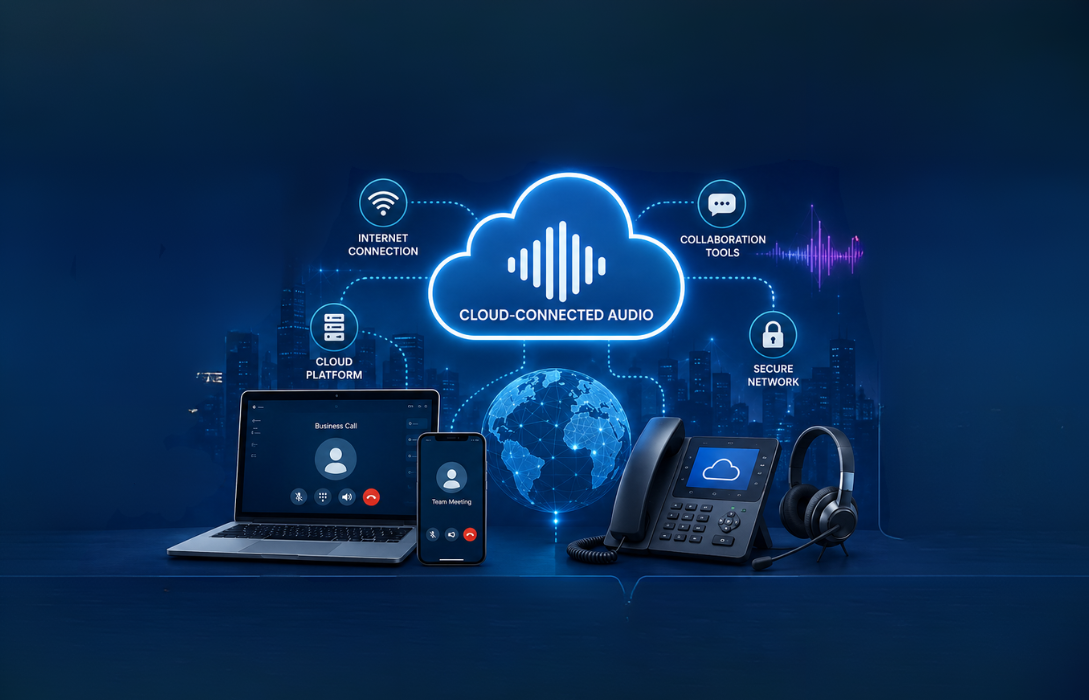
Modern businesses need communication systems that are fast, flexible and accessible from anywhere. Cloud-connected audio is transforming business communication by delivering voice calls through cloud platforms instead of traditional phone lines. Using technologies such as Voice over Internet Protocol (VoIP), SIP trunking, and cloud telephony organizations can make secure calls, host virtual meetings and collaborate seamlessly across multiple devices. As remote and hybrid work continue to grow, cloud-based audio has become an essential part of modern workplace communication.
Beyond improving call quality, cloud-connected audio helps businesses reduce infrastructure costs, scale communication systems with ease, and integrate voice services with platforms like Microsoft Teams, Zoom, and Cisco Webex. Whether you’re an IT professional, business owner, or network administrator, understanding this technology is increasingly important. This guide explains how cloud-connected audio works, its benefits, leading providers, implementation best practices, and future trends to help you choose the right solution for your organisation.
What Is Cloud-Connected Audio?
Cloud-connected audio is a communication technology that delivers voice calls through cloud-based platforms instead of relying entirely on traditional telephone infrastructure. Rather than using an on-premises Private Branch Exchange (PBX) system, businesses route voice traffic through secure cloud servers connected to the internet.
When someone makes a call, the audio is converted into digital data packets using Voice over Internet Protocol (VoIP). These packets travel across internet networks, where cloud servers process and route them to the intended recipient. The recipient’s device then converts the digital packets back into clear audio.
Cloud-connected audio supports a wide range of communication tools, including business phone systems, online meetings, video conferencing, customer support platforms, and collaboration software.
Core Technologies
Cloud-connected audio relies on several technologies working together:
- Voice over Internet Protocol (VoIP)
- Cloud PBX
- SIP Trunking
- Unified Communications (UC)
- Artificial Intelligence voice processing
- Cloud telephony services
Together, these technologies create a flexible communication system suitable for businesses of all sizes.
Traditional Phone Systems vs Cloud-Connected Audio
| Traditional Phone System | Cloud-Connected Audio |
| Requires physical PBX hardware | Uses cloud infrastructure |
| Expensive upgrades | Easy to scale |
| Limited to office location | Accessible from anywhere |
| High maintenance costs | Automatic updates |
| Costly international calls | Lower communication costs |
| Manual management | Centralised cloud management |
Why Cloud-Connected Audio Matters

Modern organisations are rapidly adopting cloud communication because it improves collaboration while reducing infrastructure costs.
Supports Remote and Hybrid Work
Employees no longer need to work from a central office to stay connected. Cloud-connected audio allows staff to join meetings, answer business calls, and collaborate using laptops, smartphones, or desktop applications from virtually anywhere.
Scales with Business Growth
As organisations expand, communication requirements also increase. Traditional phone systems often require new hardware installations, while cloud solutions allow businesses to add users, locations, and phone numbers within minutes.
Better Team Collaboration
Cloud-connected audio integrates with collaboration platforms, enabling employees to switch between messaging, voice calls, video meetings, and file sharing without changing applications.
AI-Powered Communication
Many modern cloud communication platforms include intelligent features such as:
- Real-time transcription
- Background noise reduction
- Automated meeting summaries
- Live language translation
- Voice analytics
These features improve productivity while reducing manual administrative tasks.
How Cloud-Connected Audio Works
Although the technology may seem complex, the communication process follows a straightforward sequence. First a user initiates a call using a softphone application, collaboration platform, or business phone. The system converts the speaker’s voice into digital packets using VoIP technology. These encrypted packets travel securely across the internet to cloud communication servers. The cloud platform processes the audio and applies routing rules, security policies, and quality optimization before forwarding the call.
If the recipient is using another cloud application, the voice reaches them directly. If they are using a traditional phone, the cloud platform connects through a SIP gateway or Public Switched Telephone Network (PSTN). Finally, the recipient’s device converts the digital packets back into high-quality audio.
Basic Communication Flow
User Device
│
▼
VoIP Application
│
▼
Internet
│
▼
Cloud Communication Platform
│
▼
SIP Gateway / PSTN
│
▼
Recipient Device
This architecture allows businesses to connect cloud applications with traditional telephone systems while maintaining excellent voice quality.
Key Benefits of Cloud-Connected Audio
High-Quality Voice Communication
Leading cloud providers operate global data centres that optimise network routes, reducing latency and improving call quality. Many platforms also use AI-powered noise suppression and echo cancellation to deliver clearer conversations.
Lower Communication Costs
Cloud-connected audio eliminates many expenses associated with traditional telephony, including hardware maintenance, dedicated phone infrastructure, and costly international calls. Businesses typically pay only for the services they use, making cloud communication a cost-effective solution.
Easy Scalability
Organizations can quickly add new users, departments, or office locations without investing in additional PBX hardware. Resources automatically scale according to business requirements.
Improved Business Continuity
Since communication systems are hosted in the cloud, employees can continue working even if office access is disrupted. This improves disaster recovery and ensures uninterrupted business operations.
Global Accessibility
Cloud-connected audio supports employees, customers, and partners across different countries. Staff can access business communication tools using computers, mobile devices, or web browsers from almost any location with an internet connection.
Seamless Integration
Cloud audio platforms integrate with Customer Relationship Management (CRM) systems, productivity software, collaboration tools, and customer service applications, creating a unified communication environment.
Leading Cloud-Connected Audio Providers
Several technology companies offer reliable cloud communication solutions for businesses.
| Provider | Best For |
| Microsoft Teams | Enterprise collaboration |
| Cisco Webex | Large organisations |
| Zoom Phone | Remote and hybrid work |
| RingCentral | Business communication |
| Google Meet | Google Workspace users |
| Dialpad | AI-powered voice services |
| 8×8 | Global communication |
| Amazon Chime | AWS environments |
When choosing a provider, businesses should compare reliability, security, pricing, integration capabilities, customer support, and scalability.
How to Implement Cloud-Connected Audio

Successful implementation begins with understanding business communication requirements.
Start by assessing the number of users, expected call volume, network bandwidth, security requirements, and future growth plans.
Next, choose a cloud communication provider that matches your business goals and integrates well with your existing software.
Configure VoIP settings, SIP trunks, codecs, firewall rules, and call routing to ensure efficient voice transmission.
If your organisation still uses traditional phone lines, integrate the cloud platform with the Public Switched Telephone Network (PSTN) using SIP gateways or telecom provider services.
Network optimization is equally important. Implement Quality of Service (QoS) policies to prioritise voice traffic, minimize latency, and reduce packet loss.
Finally, secure the communication environment using encryption, identity management, multi-factor authentication, firewall protection, and continuous monitoring.
Security Best Practices
Voice communication carries sensitive business information, making security a top priority.
Businesses should protect cloud-connected audio systems by implementing:
- End-to-end encryption
- Multi-factor authentication (MFA)
- Secure identity management
- Firewall protection
- Access control policies
- Regular software updates
- Continuous network monitoring
- Secure backup and disaster recovery plans
A well-secured communication system reduces the risk of cyberattacks and unauthorised access.
Common Challenges
Despite its many advantages, cloud-connected audio also presents some challenges.
Poor internet connectivity can reduce call quality and increase latency. Network congestion may result in packet loss during peak usage periods.
Migrating from legacy phone systems may require careful planning to avoid service interruptions. Employees may also need training to adapt to new communication platforms.
These challenges can be addressed through proper network design, bandwidth management, staff training, and selecting a reliable cloud provider.
Future Trends
Cloud-connected audio continues to evolve alongside advances in artificial intelligence and cloud computing.
Future developments are expected to include smarter AI assistants capable of generating meeting summaries, analysing conversations, and providing real-time language translation.
Edge computing will reduce latency by processing voice data closer to users, improving communication quality worldwide.
Businesses are also expected to adopt immersive collaboration technologies such as spatial audio and virtual meeting environments, creating more engaging communication experiences.
As organisations increasingly embrace digital transformation, cloud-connected audio will remain a core component of modern business communication.
Conclusion
Cloud-connected audio has transformed the way organisations communicate by replacing traditional telephone infrastructure with flexible, internet-based communication systems. By combining cloud computing, VoIP, SIP trunking, and artificial intelligence, businesses can create scalable, secure, and cost-effective communication environments that support today’s remote and hybrid workforce.
Whether you’re a small business looking to reduce communication costs or a global enterprise seeking seamless collaboration, cloud-connected audio offers the flexibility and performance needed to stay connected. As cloud technologies continue to evolve, organisations that invest in modern communication solutions will be better positioned to improve productivity, strengthen collaboration, and adapt to the future of work.
FAQs
What is cloud-connected audio?
Cloud-connected audio is a communication technology that delivers voice calls through cloud infrastructure using internet protocols instead of traditional telephone systems.
Is cloud-connected audio the same as VoIP?
No. VoIP is one of the core technologies behind cloud-connected audio, while cloud-connected audio also includes cloud platforms, unified communications, AI features, and collaboration tools.
Which businesses benefit most from cloud-connected audio?
It is ideal for IT companies, customer support centres, healthcare providers, educational institutions, financial organisations, remote teams, and multinational businesses.
Is cloud-connected audio secure?
Yes. Most providers use encryption, authentication, access controls, and continuous monitoring to protect business communications.
Can small businesses use cloud-connected audio?
Absolutely. Cloud-based communication solutions are scalable and affordable, making them suitable for businesses of all sizes without requiring expensive hardware investments.