If you have ever wandered through an anime fan community and seen the phrase doujen moe, you probably noticed it used like everyone already knows what it means. The term pops up in fan-art threads, forum discussions and convention circles, yet it rarely comes with a definition. That is because doujen moe is not a fixed genre or an official label. It is a feeling, a shared aesthetic and a way of talking about a very specific kind of emotional connection that fans have with independent, self published work.
This guide breaks down what doujen moe actually means, where it comes from and how you can find and even create it yourself.
What Is Doujen Moe, Really?
If you spend time in anime fan spaces, you may have come across the phrase doujen moe. At first glance it sounds like a specific genre or an official term. It is neither. Doujen moe is a fan made label for a feeling more than a format.
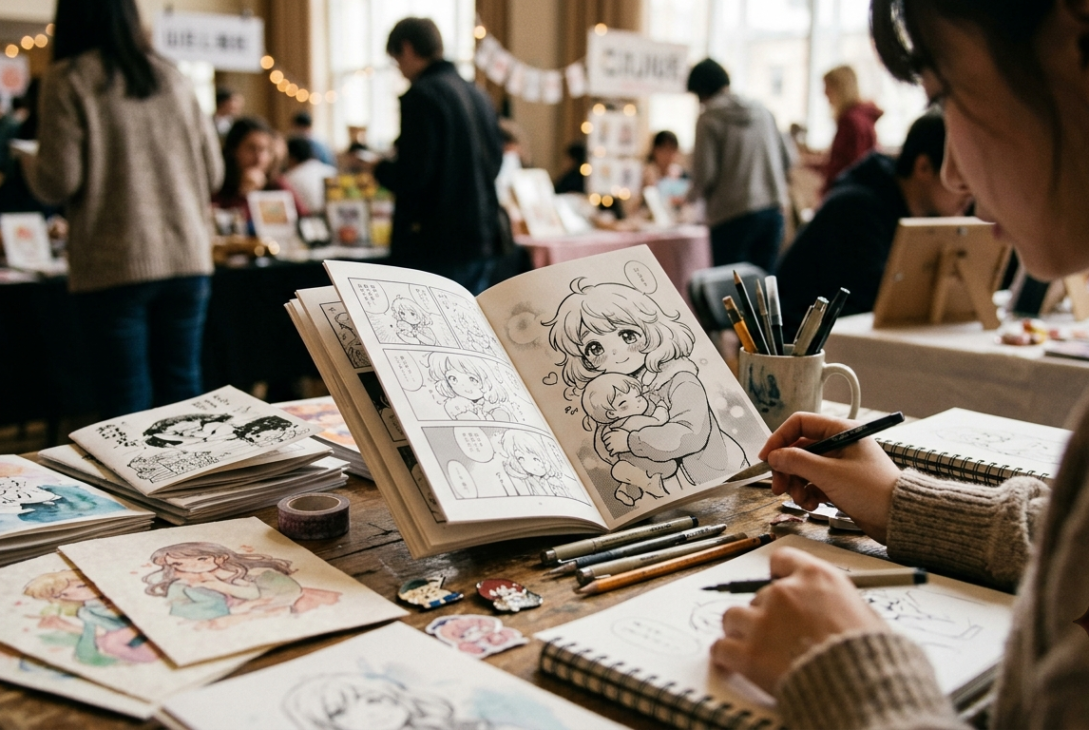
The phrase points to independent, fan made creative work built to spark a warm, almost protective affection for its characters. This includes manga, illustrations, short comics and art books made outside the major publishing houses. The work is often personal and emotionally honest in ways commercial manga rarely is.
What makes doujen moe hard to pin down is that no single authority defines it. It is not a dictionary word and it has no accepted, fixed meaning. Instead it works as a symbolic fandom term, a label people use in fan works and online communities to signal a shared emotional vibe.
Because the community defines it, doujen moe can mean slightly different things in different spaces. For some it signals creative passion. For others it marks emotional attachment or fandom identity. The meaning shifts with context, which is why a one line definition always feels a little off.
Two Words, One Felt Aesthetic
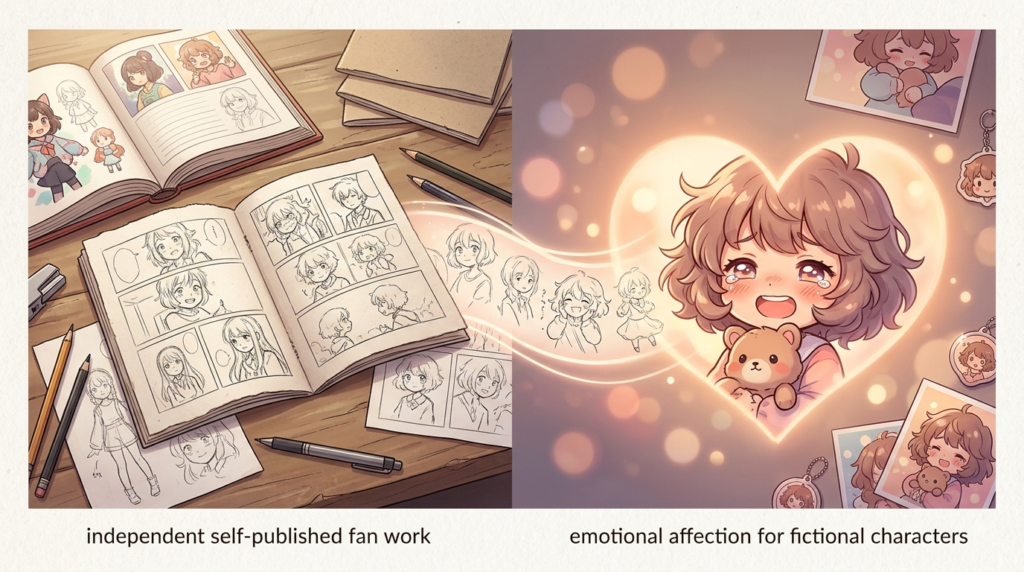
Break the phrase in half and it becomes clearer. The first part, doujen, is a variant spelling of doujin, referring to self published or fan made works created outside corporate control. The second part, moe, names the emotional payoff these works aim for.
Put together, doujen moe is less an object than an experience. It is the warmth a piece of indie work produces, the affection that makes you care what happens to a character. You do not collect doujen moe the way you collect manga volumes. You recognize it when a fan comic makes your chest tighten.
Why It Has No Dictionary Definition
There is an honest caveat every explainer should carry. Moe as doujen is not found in official literature, dictionaries, or mainstream media. In that formal sense it is constructed, even fictional. But it is clearly real in digital culture, where people use it daily in fan works and forums.
That gap, between official absence and everyday use, is the whole point. Doujen moe exists because a community willed it into being, not because an institution approved it. Any neat definition, including this one, is a working approximation rather than a final ruling.
The Two Roots: Doujin and Moe

To use the term well, it helps to understand its two foundations. Doujinshi represents the creation model, the how. Moe defines the emotional outcome, the why. Grasp both and the compound stops feeling mysterious.
Doujinshi: The Self-Published Backbone
Doujinshi are self-published works, often manga, novels, or art books, made by independent artists or small groups called doujin circles. Many are parodies or spin-offs of popular commercial works, but a growing number are original stories rooted in personal expression.
Artists sell these works at conventions, through small print runs, and on online platforms. They control the creative direction and answer to no big studio. That independence is the structural base for doujen moe, because emotional honesty rarely survives a commercial editing process.
Moe: Affection, Not Just Cuteness
Moe, written 萌え, is Japanese slang for a strong, often protective affection toward fictional characters. It is not simply cuteness, and it is not always romantic. People feel moe when a character seems adorable, vulnerable, or deeply relatable, the kind of warmth that makes you invested in their fate.
The term’s origin is genuinely uncertain. It first became popular in 1993–94 among users of Japanese bulletin board systems. Several theories trace it to character names like Moe Sagisawa from the 1993 anime Kyōryū Wakusei, or to the verb moeru, meaning to bud or sprout, which is homophonous with a verb meaning to burn with passion.
That ambiguity matters. Moe was born in fan conversation, not in a studio pitch meeting, which is why it pairs so naturally with doujin. Both halves of doujen moe come from the same grassroots place.
Where Doujen Moe Comes From
Doujen moe traces back to Japan’s doujinshi culture, where fans have gathered for decades at events like Comiket to sell and trade self published manga. These conventions let creators share work without studio backing and build direct relationships with readers.
From Meiji-Era Circles to Comiket
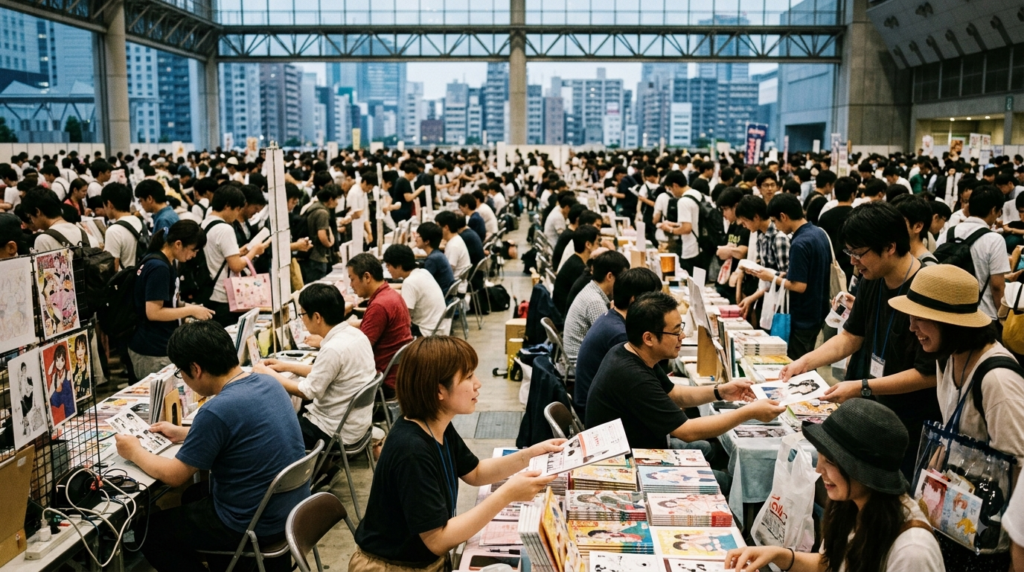
The doujinshi tradition has deep roots, with like minded creators collaborating on independent projects as far back as the Meiji era. The modern version took shape when Comic Market, known as Comiket, launched in Tokyo on December 21, 1975, with an estimated 700 attendees.
Comiket was founded by Meikyu, a doujin circle of Yoshihiro Yonezawa, Teruo Harada, and Jun Aniwa while they studied at Meiji University. It grew into the largest fan convention in the world, with an estimated turnstile attendance of 750,000 in 2019.
By Comic Market 103 in December 2023, the event hosted roughly 26,000 circles and 270,000 participants. It has been held at Tokyo Big Sight since the fiftieth event in 1996, and that direct creator to fan energy still anchors doujen moe today.
How the Internet Globalized the Movement
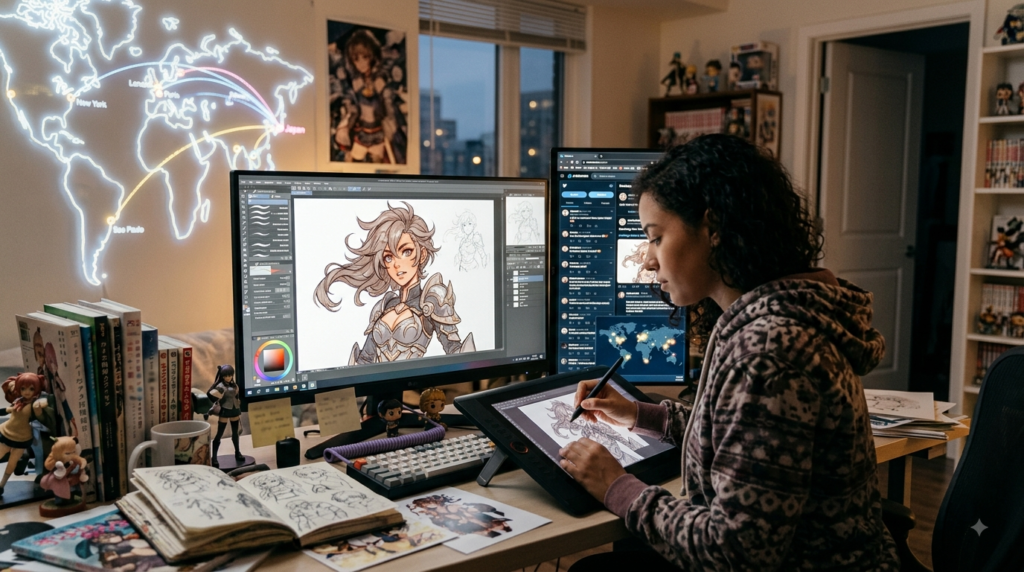
The internet changed everything for doujen moe. By the early 2000s, online communities grew as fans shared art on platforms like Pixiv and DeviantArt. Suddenly an artist in Tokyo could reach someone in New York instantly.
Social media and archive sites let doujen moe spread beyond physical conventions. Digital platforms enabled rapid discovery, remixing, and discussion, which helped the subculture persist and evolve far beyond Japan’s borders.
What began as photocopied comics sold at local conventions turned into a worldwide movement. Western fans now produce doujin inspired zines, Korean and Southeast Asian artists contribute emotional fan comics and online communities translate and share works across borders.
How Doujen Moe Differs From Mainstream Moe
This is the distinction most explainers flatten. Traditional moe is typically defined by recognizable character tropes and industry driven standards. Doujen moe, by contrast, is shaped by community belonging and self expression, valuing imperfection and personal storytelling.
Passion Over Polish
In commercial manga, moe can function as a marketing strategy, a way to engineer attachment for mass appeal. In doujinshi, moe is more often a labor of love, intimate, nuanced and genuine, made without the pressure to sell at scale.
That difference shows in the work. Doujen moe pieces sometimes pair affection with melancholy or vulnerability in ways a publisher would never greenlight. The rough line art and niche subject matter are not flaws. They are signs that the creator answered to no one but their audience.
The Labor of Love Problem
There is an honest tension worth naming. Because doujen moe resists commercial homogenization, creators often work with tiny print runs, thin margins and little institutional protection. The same independence that produces emotional authenticity also leaves artists financially exposed.
The vulnerability is part of what gives doujen moe its weight, but it is also why supporting these creators directly, through platforms and events, matters more than passive appreciation. Buying from a circle at a convention or through their Booth store keeps the ecosystem alive.
Where Doujen Moe Lives Today
Doujen moe occupies both physical and digital spaces, and the two feed each other. Conventions remain the spiritual home, but online platforms now carry the day to day conversation and commerce.
Conventions: Comiket, Comitia, and Artist Alleys
Comiket in Tokyo remains the holy grail of doujinshi, held twice a year. Comitia is a convention focused on original works rather than derivative ones, offering a clearer window into doujen moe’s original creation side.
Western equivalents include Artist Alleys at major anime conventions like Anime Expo and Otakon, where doujen moe creators sell prints, zines, and original character merchandise directly to fans. These spaces preserve the gatekeeper free ethos that defines the movement.
Digital Platforms and Archives
Discovery now happens across multiple channels. Digital platforms like Pixiv and Booth dominate sharing and sales, while retailers like Melonbooks and Toranoana support physical distribution in Japan.
Online, fans gather on Reddit and other communities to share, translate and discuss works. Sites like Doujinshi.org and Booth.pm function as archives and storefronts, letting a global audience find doujen moe without ever setting foot in Tokyo Big Sight.
How to Find, Read, and Make Doujen Moe Work
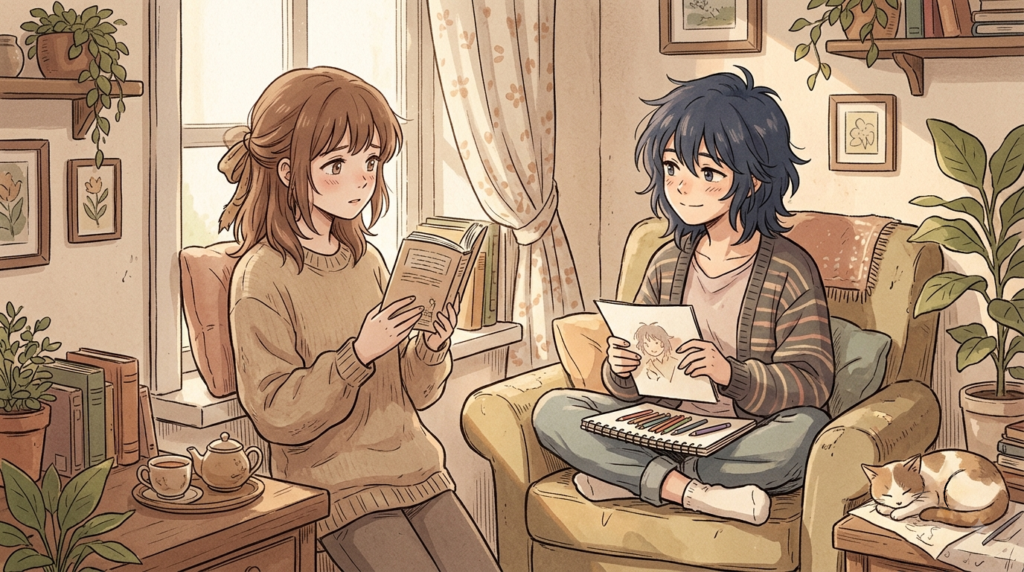
If you want to do more than read about doujen moe, the practical entry points are surprisingly accessible. The barrier is taste, not access. You simply need to know what to look for and where people gather.
Recognizing the Aesthetic
Start by training your eye on the emotional cues. Doujen moe prioritizes feeling over technical polish, so look for work that lingers on quiet moments, vulnerability, and character intimacy rather than action or spectacle. Slice of life scenes and kawaii character design are common tells.
Genres like Boys’ Love, kawaii aesthetics and slice of life storytelling recur frequently, all used to evoke moe. But the real signal is intent. If a piece seems designed to make you care about a character rather than impress you with craft, you are likely looking at doujen moe.
Starting as a Creator
If you want to make doujen moe yourself, begin with a character you feel genuinely protective toward. The work does not need to be technically refined. It needs emotional honesty, the kind that comes from caring what happens to the people on the page.
Self publish through small print runs, a Booth store, or a Pixiv portfolio and share at a local Artist Alley if possible. The community prizes collaboration over competition, so engaging with other creators matters as much as the work itself.
It is fine to be uncertain along the way. Doujen moe is a learned sensibility, not a formula, and even experienced creators disagree about where its boundaries sit. That disagreement is healthy and a sign of a living culture rather than a fixed genre.
Conclusion
Doujen moe endures because it answers a need for commercial manga. It offers emotional authenticity, direct creator to fan contact, and a space where imperfect, personal work is valued on its own terms. The term may resist tidy definition, but that fluidity is its strength.
What started in Meiji-era circles and grew through Comiket now lives across Pixiv, Boot, and Artist Alleys worldwide. Whether you are a reader chasing that warm, protective feeling or a creator learning to evoke it, doujen moe rewards attention. It is a living culture and the best way to understand it is simply to dive in.
FAQ’s
What does doujen moe mean?
Doujen moe combines doujin, self-published fan works, with moe, a warm protective affection for fictional characters. It describes independent, emotion-driven creative work built to make you care about its characters.
Is doujen moe a real word?
It is not in dictionaries and has no fixed, officially recognized meaning. It is a fan-coined, community-driven term that is real through use in online fandom spaces, even if it is absent from formal literature.
How is doujen moe different from doujinshi?
All doujen moe is doujinshi, but not all doujinshi is doujen moe. Doujinshi is the broad category of self-published work, while doujen moe specifically combines self-publishing with the emotional, character-focused moe aesthetic.
Where does the word moe come from?
Moe first became popular in 1993–94 on Japanese bulletin board systems. Its origin is disputed, with theories pointing to character names like Moe Sagisawa or to the verb moeru, meaning to bud or sprout, homophonous with a word for burning passion.
Where can I find doujen moe work?
Start with digital platforms like Pixiv and Booth, browse archives like Doujinshi.org, or explore Reddit communities. In person, Comiket and Comitia in Japan, and Artist Alleys at Western conventions, are the main hubs.
Do I need to be in Japan to participate?
No. While doujen moe is rooted in Japan, global audiences now create and share it widely. Western fans make doujin-inspired zines, and Southeast Asian artists contribute emotional fan comics, all connected through online platforms.
Is doujen moe the same as cute anime art?
Not exactly. Cuteness is often part of it, but moe is about emotional connection, not just appearance. A doujen moe work can be melancholy or vulnerable and still qualify, as long as it evokes genuine affection for its characters.
Can doujen moe include original characters, or only parodies?
Both. Many doujinshi are parodies of commercial works, but a growing number feature original stories. Events like Comitia specifically focus on original doujinshi, making them a strong entry point for original doujen moe.
Is doujen moe always romantic?
No. Moe is often warm and protective rather than romantic, and doujen moe works frequently explore platonic affection, everyday intimacy, and quiet character moments without any romantic framing at all.
How do I start creating doujen moe?
Begin with a character you feel protective toward, prioritize emotional honesty over polish, and self-publish through Booth, Pixiv, or small print runs. Engage with other creators at conventions or online, since the community values collaboration over competition.