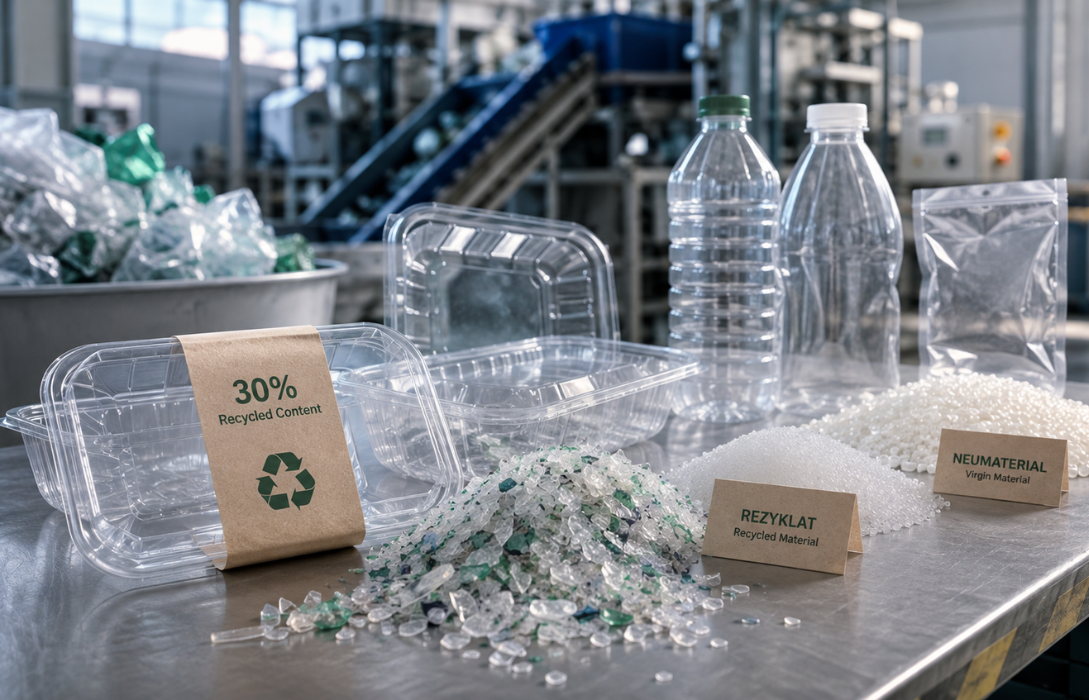
When a product or package states a particular Recyclatanteil, the underlying question is simple: How much of the material used comes from previously recycled raw materials? The term is becoming increasingly relevant to consumers, while for manufacturers, procurement teams and packaging professionals, it is already a concrete material metric.
In technical German, the terms Rezyklatanteil or Rezyklatgehalt are often used more precisely. According to the definition of DIN EN ISO 14021 referenced by the German Environment Agency, recycled content refers to the mass fraction of recycled material in a product or package.
At first glance, this sounds like a straightforward percentage. In practice, however, the figure deserves closer attention because 30% recycled content can mean different things depending on the product, material, source and calculation method. To interpret the number correctly, it is therefore important to distinguish recycled content from recycling rates and recyclability.
What Does Recyclatanteil Mean?
The term Recyclatanteil basically describes the proportion of a product or material that consists of recycled input materials. If a plastic product contains 40% recycled content, for example, 40% of the relevant material mass comes from recycled material, while the remaining portion may consist of virgin material or other materials.
In technical terminology, Rezyklat is generally the more precise German term. German circular-economy legislation defines recyclates as secondary raw materials obtained through the recovery of waste or arising during waste treatment, that are suitable for manufacturing products.
This means that Recyclatanteil is more than a general sustainability statement. It describes a specific material characteristic. However, the crucial question is always what the percentage refers to: the entire product, a particular packaging component, a plastic layer or a specific material.
How Is Recyclatanteil Calculated?
The basic calculation is straightforward: the mass of recycled material is divided by the total mass of the material being considered. If a component contains 20 kilograms of recycled material out of a total relevant material mass of 50 kilograms, the recycled content is 40%.
In practice, however, the reference quantity is particularly important. A package can contain several components, while only the plastic body has a declared recycled content. A statement such as “50% recycled content” therefore does not automatically mean that the entire package consists of 50% recycled material.
This distinction matters particularly in professional procurement and product communication. DIN SPEC 91446 was developed to support more consistent descriptions and classifications of plastic recyclates and recycled content, helping companies across the value chain work with more comparable information.
Recyclatanteil and Recycling Rate Are Not the Same
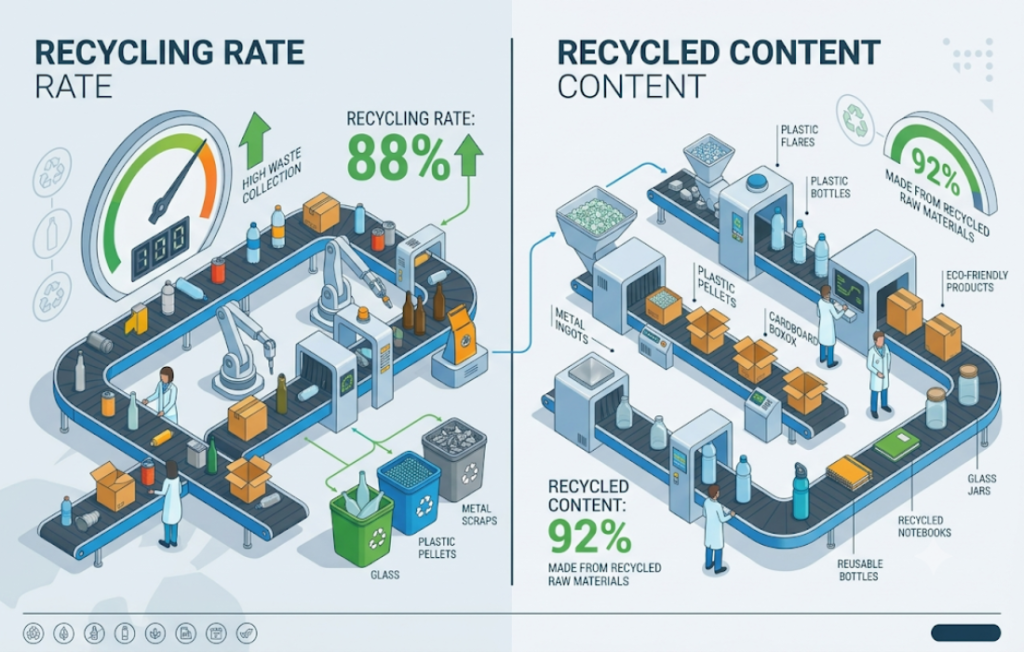
One of the most common misunderstandings concerns the difference between recycled content and the recycling rate. A recycling rate generally describes the proportion of a particular waste stream that is sent for recycling or an associated recovery process. Recycled content, by contrast, describes the recycled material that is subsequently incorporated into a new product or material.
That distinction is important. A high recycling rate does not automatically mean that new products contain a correspondingly high proportion of recycled material. Conversely, a high recycled content figure demonstrates that recycled material has actually been used again as a raw material.
The German Environment Agency therefore emphasizes that a functioning circular economy requires not only the recycling of waste but also sufficient demand for the recyclates produced from that waste. Without buyers, even well processed recycled material cannot replace larger quantities of virgin raw materials over the long term.
What Types of Recyclate Are There?
When assessing Recyclatanteil, the percentage itself is not the only relevant factor. The origin of the recycled material also matters. Two particularly important terms are post consumer recyclate and post industrial recyclate, which describe different material streams.
Post-consumer recycled material comes from products or packaging that have already been used by private or commercial consumers. Post industrial material, by contrast, is associated with production and processing waste. The German Environment Agency uses this distinction within the terminology of DIN EN ISO 14021.
The origin of the material can be important when evaluating circularity. A material stream made from used packaging creates different requirements for collection, sorting, cleaning and processing than clean production scrap. The percentage of recycled content should therefore not be considered in isolation.
Why Is a High Recyclatanteil Useful?
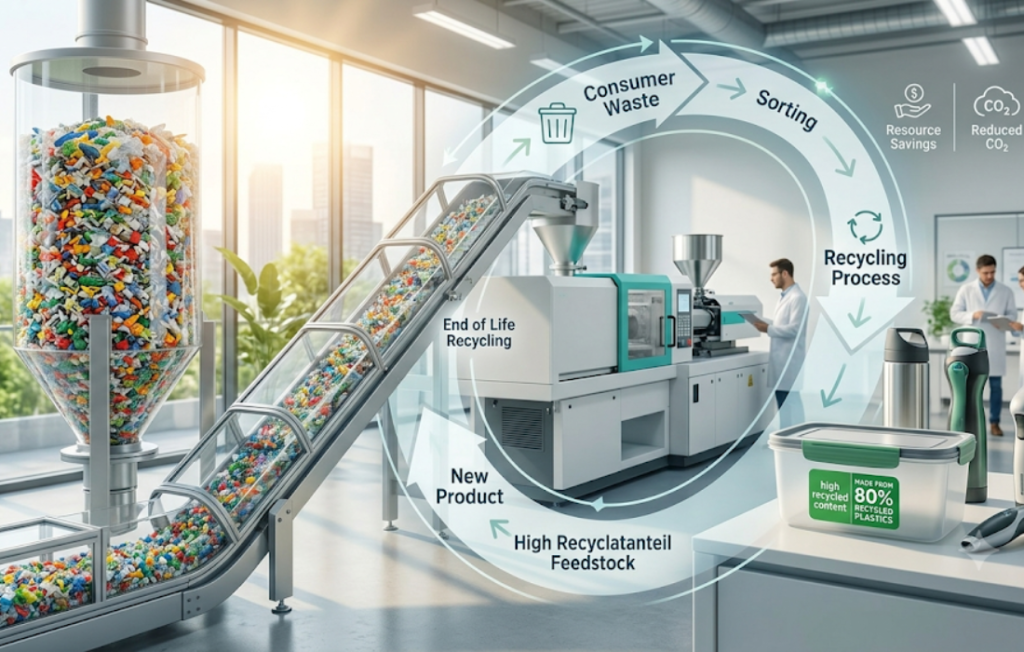
The main advantage is that recycled material can replace virgin raw materials. In plastics recycling, this generally means that less new plastic feedstock is required when existing material is returned to production. The German Environment Agency identifies resource savings and the avoidance of CO₂ emissions as important reasons for increasing the use of plastic recyclates.
A higher recycled content can also create demand for recycled material. This matters economically because recycling should not end with sorting and processing. Companies need to actually purchase and use recyclates in new products for a stable market for secondary raw materials to develop.
However, it would be misleading to automatically equate a high Recyclatanteil with an environmentally sustainable product overall. Weight, service life, material composition, manufacturing processes, transportation, use and end of life recycling can all affect environmental performance. Recycled content is therefore an important indicator, but it is not a complete environmental assessment.
How Does Recyclatanteil Work in Practice for Plastics?
Plastics illustrate particularly well why recycled content is receiving increasing attention. According to current German Environment Agency data, approximately 1.93 million tonnes of plastic recyclates were used in new products in Germany in 2023. Relative to the total amount of processed plastics, recycled material accounted for 15%.
The data also show why the source of recycled material matters. Of the plastic recyclates used in 2023, approximately 1.54 million tonnes, or 79.8%, originated from waste generated after private or commercial use. Around 0.39 million tonnes, or 20.2%, came from production and processing waste.
At the same time, recycling opportunities vary considerably. Industrial plastic waste is often cleaner and more homogeneous, while household waste can be more mixed or contaminated. This is one reason why the material recovery rates of different plastic waste streams can differ substantially.
What Role Will Recyclatanteil Play in Packaging?
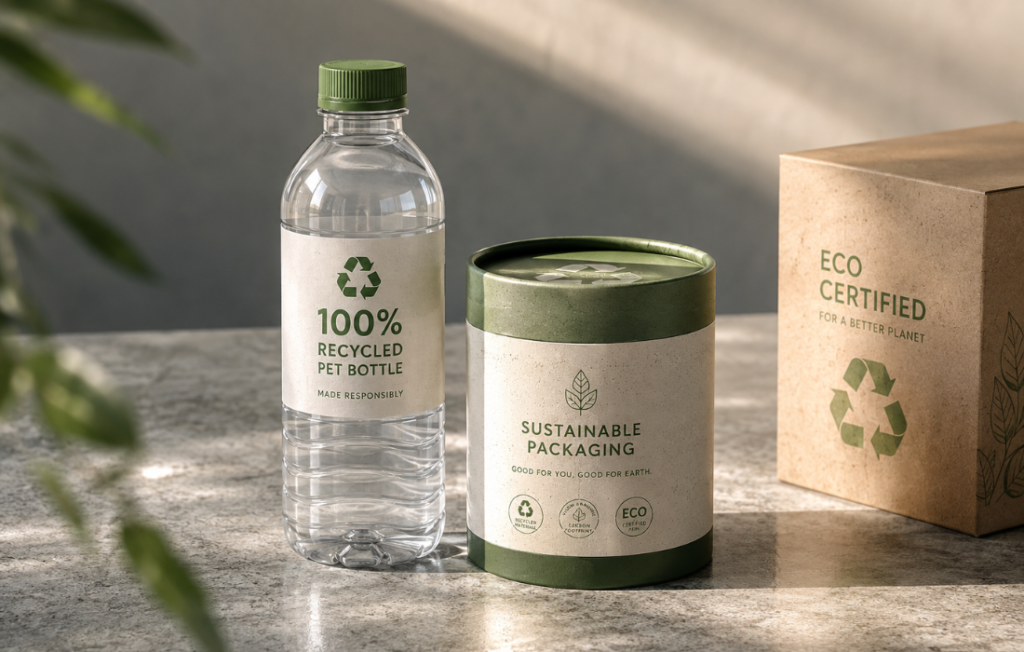
Recyclatanteil is becoming particularly important for companies working with plastic packaging. EU Regulation 2025/40 on packaging and packaging waste introduces mandatory minimum recycled-content requirements for certain plastic packaging. The first relevant minimum requirements generally apply from 2030, subject to the specific conditions and implementation provisions set out in the regulation.
For 2030, the regulation includes minimum recycled-content targets such as 30% for certain contact-sensitive PET packaging, 10% for certain other contact-sensitive plastic packaging, 30% for single use plastic beverage bottles, and 35% for other covered plastic packaging. Several of these requirements increase further for 2040.
This makes Recyclatanteil increasingly relevant to product development, procurement and compliance. Manufacturers need to consider not only how much recycled material can technically be incorporated, but also what quality of recyclate is available and how its origin and quantity can be reliably documented.
How To: How to Assess Recyclatanteil Correctly
Read the Product Statement Carefully
Consumers assessing recycled content should first determine exactly what the percentage refers to. If a bottle states that a certain percentage consists of recycled plastic, for example, this does not necessarily apply to the cap, label or every other component.
Companies should also avoid taking recycled content claims from marketing materials at face value. For professional procurement, it is important to establish which material quantity is being considered, what type of recyclate is involved, and what documentation the supplier can provide.
Check the Reference Quantity and Material Content
The percentage alone is rarely enough. A Recyclatanteil of 50% could refer to a particular plastic component or to a defined total material mass. Meaningful comparisons therefore require products to be evaluated using the same reference quantity.
This distinction can be particularly significant for composite packaging. When a product consists of several materials, it should be clear whether the stated percentage applies to the entire package or only to a particular material fraction.
Distinguish Post Consumer and Post-Industrial Recyclate
The origin of the recyclate provides additional information about the recycling loop. Post consumer recycling comes from products or packaging that have already been used, whereas production and processing waste belongs to a different material category.
For public procurement and demanding sustainability requirements, this distinction can be particularly relevant. The German Environment Agency explicitly highlights post consumer recyclates as an important approach for increasing demand for materials recovered from used plastic products.
Consider Documentation and Standards
For professional applications, a stated Recyclatanteil should be supported by verifiable documentation. Standardized material descriptions and appropriate supplier documentation can play an important role. DIN SPEC 91446 was developed, among other purposes, to provide a more consistent classification of plastic recyclates based on different levels of data quality.
This becomes particularly important when recycled content is relevant to contracts, regulations, or environmental claims. The more significant the statement, the less appropriate it is to rely on an isolated percentage without information about the reference quantity and material origin.
Do Not Evaluate Recyclatanteil in Isolation
A high Recyclatanteil is generally a useful indicator that secondary raw materials are being used. However, it does not answer every sustainability question. A fair comparison should also consider material consumption, product lifespan, manufacturing and recyclability at the end of the product’s life.
This prevents two common misunderstandings: “recyclable” does not automatically mean “made from recycled material” and “high recycled content” does not automatically mean “environmentally friendly in every respect.” Understanding this distinction makes the metric much more meaningful.
Conclusion
Recyclatanteil is ultimately a simple metric with more complexity behind it than its percentage suggests. It answers the question of how much of a defined material quantity comes from recycled material, but it does not by itself determine how sustainable an entire product is.
For consumers, the figure provides a useful indication when comparing products based on their use of secondary raw materials. For businesses, it is becoming increasingly important for material selection, procurement, product development and regulatory compliance.
The most important point is therefore not simply achieving the highest possible percentage. What matters is having a clear, verifiable and comparable recycled content claim. Once Recyclatanteil, recycling rate, material origin and recyclability are properly distinguished, the metric becomes much easier to understand and use.
FAQs
What Does Recyclatanteil Mean?
Recyclatanteil refers to the proportion of recycled material within a defined total material quantity of a product or package. In technical terminology, the term recycled content or Rezyklatgehalt is often used. DIN EN ISO 14021 defines recycled content in terms of the mass fraction of recycled material in a product or package.
What Is a Good Recyclatanteil?
There is no universally “good” recycled content percentage because the appropriate level depends on the product, material, application and available recyclate. A high percentage can be beneficial, but it should be considered together with material origin, quality, functionality and end of life recyclability.
Is Recyclate the Same as Recycled Material?
The terms are often used similarly in everyday language. However, Rezyklat more precisely refers to a secondary raw material obtained through recovery processes and suitable for use in manufacturing new products. German circular economy legislation contains a specific definition of the term.
What Is the Difference Between Recyclatanteil and Recycling Rate?
Recyclatanteil describes how much recycled material is contained in a product or defined material quantity. A recycling rate, by contrast, describes how much of a particular waste stream is sent to recycling or an associated recovery process. The two metrics therefore refer to different stages of the material cycle.
Is a Product With High Recyclatanteil Automatically More Sustainable?
No. Recycled content can help reduce the use of virgin raw materials and can therefore provide an important environmental benefit. However, other factors also matter, including material quantity, product lifespan, manufacturing, transportation and recyclability. One metric cannot replace a complete life cycle assessment.
What Does Post Consumer Recyclate Mean?
Postconsumer recycling is made from materials that have been used by private or commercial end users and subsequently become waste. This distinguishes it from material originating from production or processing operations. The distinction is recognized within the terminology associated with DIN EN ISO 14021.
What Does Post Industrial Recyclate Mean?
Postindustrial recycling refers to recycled material originating from production and processing waste or related industrial material streams. Such waste can sometimes be cleaner and more homogeneous than mixed household waste, which can affect its processing requirements and possible applications.
Are There Legal Requirements for Recyclatanteil?
Yes. EU Regulation 2025/40 contains minimum recycled-content requirements for certain plastic packaging. Several packaging categories are subject to minimum requirements from 2030, with higher requirements applying to several categories from 2040. The exact requirements depend on the packaging type, material and applicable provisions of the regulation.