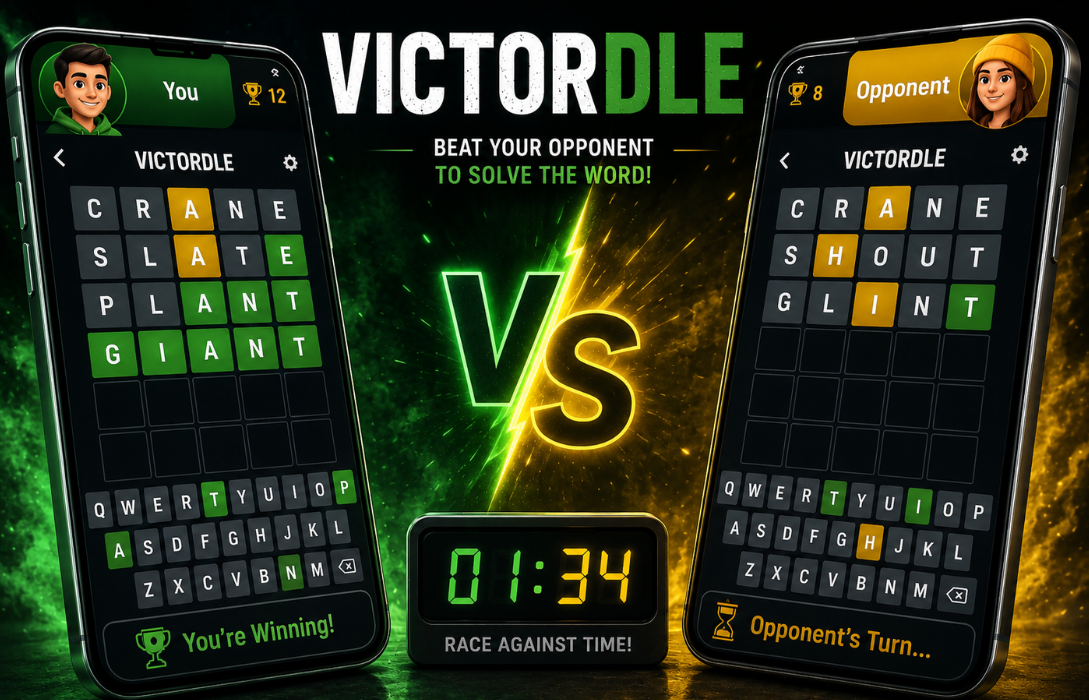
If you enjoy Wordle but find yourself wishing there were another player on the other side of the screen, Victordle adds exactly that competitive pressure. Instead of solving a five letter mystery word in isolation, you are trying to uncover it before someone else does. That changes the puzzle from a quiet vocabulary exercise into a race involving deduction, timing and nerves.
The basic concept is familiar: enter a valid five-letter word and use color feedback to narrow the possibilities. Green indicates a correctly placed letter, yellow indicates a letter that belongs somewhere else and gray indicates that the letter is not part of the target under the game’s feedback rules. The important difference is that another player is receiving information and making decisions at the same time.
That shared competition makes a surprisingly large difference. In ordinary Wordle, spending an extra guess to test several letters can be sensible because there is no opponent waiting to capitalize on your hesitation. In Victordle, the same exploratory move can be costly if the other player uses a more efficient guess and reaches the answer first.
What Is a Victordle?
Victordle is a head to head word guessing game built around a hidden five-letter word. Search results describing the current game consistently identify two central modes, Turn-by-Turn and Duel, although some third-party pages disagree about exact timing details. The official-looking Victordle site describes both modes and presents the game as a browser based competitive word puzzle.
The central objective is straightforward: identify the hidden word before your opponent. Both players work from the same underlying puzzle, which means every useful piece of information can become strategically important. A strong player therefore needs more than vocabulary; they need to recognize which guess will reduce uncertainty most efficiently.
That is the real appeal of the format. You are not simply asking, “What word fits these letters?” You are also asking, “What is the best use of my next guess, and how much time can I afford to spend finding it?” Those questions make the game feel considerably more dynamic than a conventional solo word puzzle.
How Victordle Works
The core mechanic should feel immediately familiar to anyone who has played Wordle. You enter a five letter word, submit it, and receive visual feedback that tells you which letters are correctly positioned, which occur elsewhere in the target, and which can generally be eliminated. Current descriptions of the game agree on this basic color coded system.
A green tile is the strongest possible confirmation because it tells you both the identity and position of a letter. A yellow tile gives you a different kind of information: the letter matters, but its current position is wrong. Gray feedback is useful in another way because it can remove letters from consideration and shrink the remaining search space.
The crucial point is that a color is not merely a score indicator. It is evidence. Strong Victordle play comes from treating every submitted word as an experiment designed to reveal something useful, rather than simply throwing another plausible answer at the board and hoping it works.
Victordle Game Modes
Turn by Turn Mode
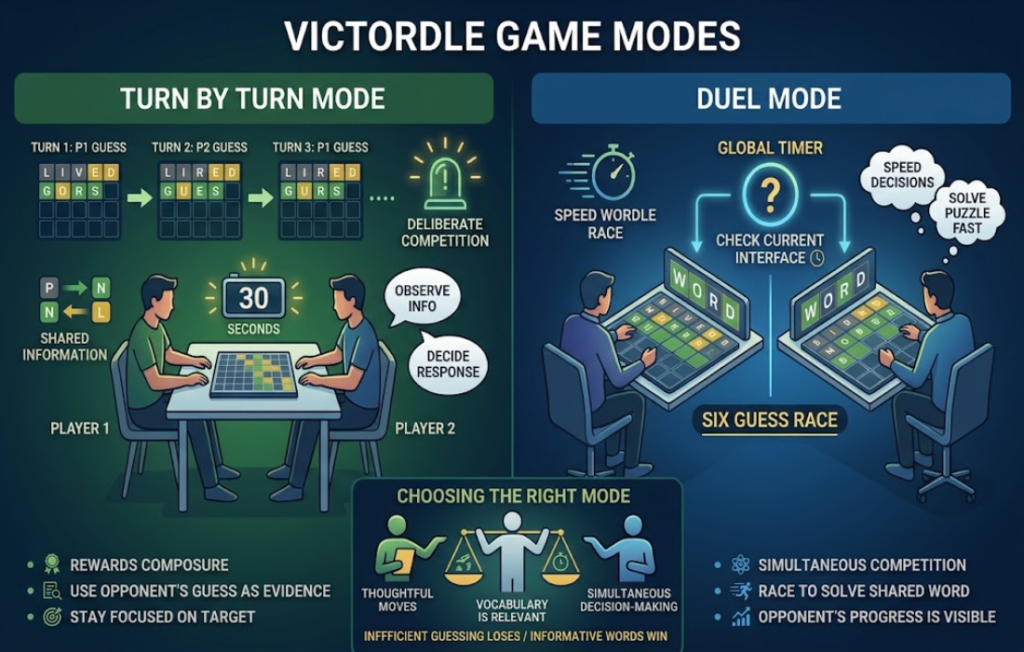
Turn by Turn mode makes the competition more deliberate because players alternate their guesses. The Victordle site describes a limit of up to 30 seconds for each turn, creating a format where you can observe the information generated during the other player’s turn before deciding how to respond.
This mode rewards composure because your opponent’s guess can become useful information. If their attempt reveals a green or yellow letter, you are not starting your next turn from exactly the same knowledge state as before. You can use that evidence when constructing your own guess, provided you remain focused on the actual target rather than simply copying the opponent’s approach.
Duel Mode
Duel mode is more directly competitive because both players work on their boards simultaneously. Current descriptions characterize it as a race to solve the shared five letter word within the available guesses, while the opponent’s board provides a visible indication of their progress.
There is some inconsistency among third-party pages about the exact global time limit in Duel mode. One source describes a 60-second limit across six attempts, while the Victordle site’s current description emphasizes the six guess race without clearly stating the same overall timer. Because of that discrepancy, players should rely on the timer actually displayed by the current game interface rather than an unofficial guide.
Choosing the Right Mode
The best mode depends on what you find difficult. Turn by Turn is attractive if you enjoy thinking about each move and using the opponent’s previous guess as additional evidence. Duel is better suited to players who enjoy simultaneous decision-making, because you must solve the linguistic puzzle while knowing that every second may allow the other player to move closer to the answer.
Neither mode makes vocabulary irrelevant, but neither is purely a vocabulary contest either. A player with an enormous vocabulary can still lose through inefficient guessing, while someone with a more modest vocabulary can perform well by choosing informative words and interpreting the available clues accurately.
How to Play Victordle
Starting a Match
To begin, choose the available game mode and enter a match against another player or challenge a friend where the current interface provides that option. The game is designed to operate in a browser and current descriptions say that no download is required for the web version.
Once the board appears, your immediate objective should not necessarily be solving the word. Your first job is to create useful information. A strong opening guess tests several common letters while avoiding unnecessary repetition, giving you a better foundation for the guesses that follow.
Making Your Opening Guess
An opening word should ideally contain several useful letters rather than merely being a word you happen to know. Common vowels can be valuable because discovering the vowel structure of a five letter word can dramatically reduce the number of plausible candidates. Consonants with broad English usage can provide similar information.
However, there is no universally perfect opening word for every competitive situation. The right choice depends on whether you prioritize vowel discovery, common consonants, positional information or familiarity. What matters most is that the guess gives you information you can actually use on the next turn.
Reading the Feedback
After submitting your guess, treat the colored tiles as constraints. A green letter locks a position, a yellow letter tells you that the character belongs elsewhere and a gray letter usually removes a candidate from consideration. Combining those constraints is much more powerful than looking at each tile independently.
Suppose your first guess reveals that one vowel is present but misplaced, while two common consonants are correctly positioned. Your next word should exploit that structure rather than simply trying another random five-letter word. The objective is to reduce uncertainty while preserving as many useful possibilities as possible.
Managing Time and Remaining Possibilities
Time pressure creates a temptation to guess the first plausible word that comes into your head. That can work occasionally, but it is a fragile strategy. A better approach is to use your available seconds to identify the strongest constraints, mentally group the remaining candidates, and then choose a word that either solves the puzzle or provides valuable additional evidence.
There is also a point where analysis becomes counterproductive. If only a few plausible words remain and one clearly fits the clues, continuing to search for a more theoretically optimal guess can cost the time you need to submit the obvious answer. Competitive word games reward judgment as much as calculation.
Finishing Before Your Opponent
Winning requires more than eventually finding the correct word. Your opponent is solving the same puzzle, so a technically correct answer submitted too late is still a loss. That means your strategy should gradually shift from information gathering toward decisive solving as soon as the board provides enough evidence.
This distinction is one of the most important habits to develop. Early guesses should maximize useful information, while later guesses should increasingly maximize the probability of identifying the answer. The strongest play is therefore adaptive rather than rigid: the best type of guess changes as the puzzle becomes clearer.
Victordle Strategy: How to Improve Your Chances
Choose Information Rich Opening Words
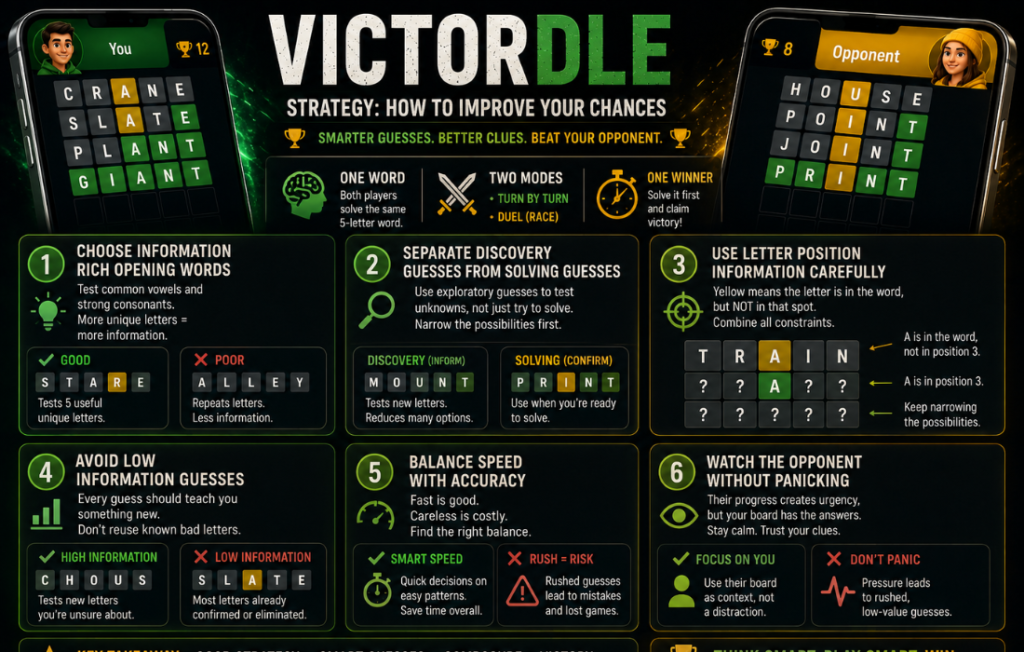
The opening move has disproportionate importance because it establishes your information base. A useful starting word can test several distinct letters and provide clues about vowel placement, consonant presence and possible word structure. A poor opening can leave you spending subsequent turns merely discovering information you could have tested earlier.
It is also worth remembering that “common” does not automatically mean “good.” A word containing several repeated letters may be familiar, but repeated characters can reveal less than a word containing five distinct, useful characters. The objective is not to demonstrate vocabulary; it is to extract information efficiently.
Separate Discovery Guesses From Solving Guesses
One of the easiest strategic mistakes is treating every guess as though it must be the answer. Sometimes the best move is an exploratory word that deliberately tests several unresolved letters. That can be particularly valuable when multiple candidate answers share the same known pattern.
Imagine that your board leaves several possibilities with identical confirmed letters. Guessing one candidate immediately might solve the puzzle, but guessing a strategically chosen alternative can distinguish between several possibilities at once. In a competitive game, however, this tactic must be balanced against the opponent’s progress.
Use Letter Position Information Carefully
A yellow letter is not simply a “nearly correct” letter. It creates a positional restriction. If a letter appears yellow in one location, your future guesses should place it elsewhere while respecting every other confirmed constraint. The more constraints you combine, the smaller your plausible answer set becomes.
This is especially important when a word contains repeated letters. Players can easily assume that one occurrence of a character proves something about another occurrence, when the actual feedback may be more nuanced. When the board produces ambiguous-looking repeated letter patterns, rely on the game’s displayed feedback rather than an intuitive assumption.
Avoid Low Information Guesses
A low information guess is not necessarily a wrong word. It is a word that fails to meaningfully reduce uncertainty. If your board already tells you that several letters are absent, repeatedly using those letters wastes an opportunity to test something new.
The best competitive guesses usually have a purpose. You might be testing a vowel arrangement, confirming a suspected consonant, separating two candidate words or making a direct attempt at the answer. Before pressing Enter, knowing what the guess is supposed to teach you can make your play considerably more disciplined.
Balance Speed With Accuracy
Speed matters in a head to head format, but speed without accuracy is not a strategy. Submitting a careless guess simply because the timer is visible can turn a solvable position into an unnecessary mistake. Conversely, spending too long analyzing a nearly obvious answer can allow an opponent to finish first.
A useful mental rule is to become faster at familiar decisions rather than trying to think faster about everything. Once you understand how the color feedback works, interpreting common patterns should become almost automatic. That leaves more attention available for genuinely difficult positions.
Watch the Opponent Without Panicking
In Duel mode, seeing the other player’s progress can create psychological pressure. A rapidly filling board may make you feel behind even when your own clues are better. Reacting emotionally can lead to rushed guesses, which is exactly the kind of error your opponent’s progress can provoke.
Instead, treat the opponent’s board as context rather than a command. Their progress tells you something about urgency, but it does not reveal their exact reasoning or guarantee that they are close to the solution. Your own board remains the most reliable source of information.
Victordle vs. Wordle
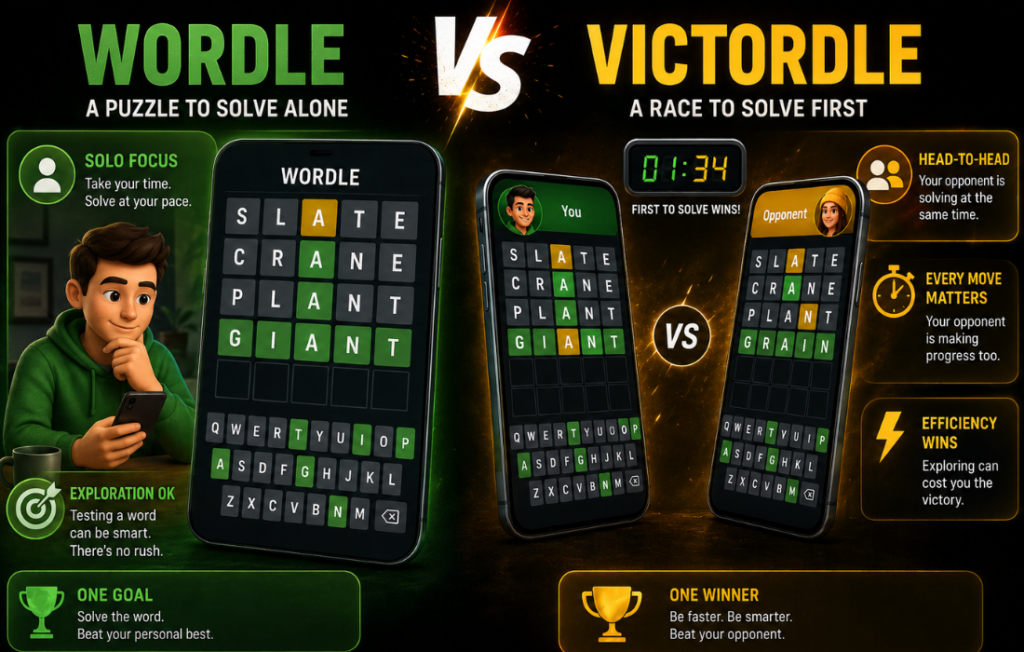
Victordle and Wordle share the fundamental five-letter, color-feedback guessing structure, so anyone familiar with Wordle can understand the basic mechanics quickly. The decisive difference is competition. Traditional Wordle is primarily a personal solving exercise, whereas Victordle turns the same style of deduction into a contest against another player.
That difference changes the meaning of efficiency. In a solo puzzle, an exploratory guess may be worthwhile simply because it improves your eventual solve. In a race, the same exploratory guess has an opportunity cost because your opponent is also spending that moment narrowing the answer.
The comparison also explains why Victordle can feel harder even when the underlying word puzzle seems familiar. The vocabulary challenge has not necessarily become dramatically different; the decision environment has. You now have another variable to manage and that variable is the other person’s progress.
Is Victordle Free and Where Can You Play?
The current Victordle site presents the game as a free browser-based experience and says it can be played on desktop and mobile devices. Another current game description likewise states that no account or download is required for browser play. Because third party versions and similarly named pages exist, players should distinguish the actual game interface from unofficial pages that merely describe it.
The safest way to approach the game is to use the current Victordle web experience rather than assuming that every page claiming to offer an APK, Steam version, extension, or mobile application is connected to the original game. Search results contain unsupported claims about downloads and extensions, so those claims should not be treated as established features without confirmation from the game’s own current interface.
Conclusion
Victordle works because it takes a familiar word puzzle and adds a genuinely consequential second player. The rules remain easy to understand, but the strategic environment becomes more complicated because every guess has both an informational value and a time cost. You are solving a word while simultaneously managing competition.
The strongest approach is therefore neither reckless speed nor endless analysis. Start by gathering useful information, interpret every color as a constraint, recognize when the candidate pool has become narrow and then switch decisively from exploration to solving. In Duel mode especially, remember that your opponent’s progress is a reason to stay focused, not a reason to abandon good reasoning.
If you already enjoy Wordle, the appeal is immediate: the underlying language puzzle remains familiar while the competitive context makes each decision matter more. And if you are new to this style of game, Victordle is approachable precisely because the rules are simple. The deeper challenge comes from learning when a guess is actually worth making.
FAQs
What Is Victordle?
Victordle is a competitive five letter word guessing game where players race to find the hidden word.
How Many Guesses Do You Get?
Players get up to six guesses to solve the hidden five-letter word.
What Do the Tile Colors Mean?
Green means the letter is in the correct position, yellow means it is misplaced and gray means it is not in the word.
What Is Turn by Turn Mode?
Turn by Turn mode lets players take turns guessing, with each turn lasting up to 30 seconds.
What Is Duel Mode?
Duel mode is a head to head race where both players try to guess the same hidden word.
Can You Play Against a Friend?
Yes, Victordle lets you challenge friends or compete against random opponents.
Do Both Players Get the Same Word?
Yes, both players receive the same hidden five-letter word to solve.
Is Victordle Similar to Wordle?
Yes, Victordle uses Wordle-style guessing and color clues but adds a competitive multiplayer experience.
Does Victordle Require a Download?
No, you can play Victordle directly in your web browser without downloading software.
What Should You Do When You Are Stuck?
Use confirmed letters, eliminate incorrect ones, and make a strategic guess to narrow down the possible answers.