
A research dossier for target company is more useful when it answers a business question instead of simply collecting facts. Anyone can assemble a company description from scattered sources, but useful research explains what the business does, what has changed, where pressure or opportunity exists and why those findings matter for the decision in front of you.
The best dossiers are therefore compact intelligence documents rather than oversized company profiles. They bring together corporate facts, market context, leadership information, competitive signals, recent developments and source evidence, then connect those pieces into a coherent interpretation. This approach is consistent with professional company research resources that emphasize organizational structure, issues, news, history and financial information.
What Is a Research Dossier for Target Company?
A research dossier for target company is a structured collection and analysis of information about a particular business. Depending on the purpose, it can support a sales conversation, investment assessment, recruitment strategy, partnership discussion, procurement decision, competitive analysis or broader strategic planning.
The important distinction is between information and intelligence. Information tells you that a company launched a product or appointed an executive. Intelligence asks what that development changes, whether it signals a broader strategic direction and whether independent evidence supports the interpretation. That analytical layer is what gives a dossier practical value.
How a dossier differs from ordinary company research
Ordinary company research often begins and ends with the company’s basic profile. A dossier goes further by organizing evidence around a defined objective. For example, a sales professional may care primarily about business priorities, organizational changes, technology initiatives and potential buying signals, while an investor may focus more heavily on financial performance, market position, ownership and risk.
This difference matters because research should be proportional to the decision. A recruiter preparing for an interview does not necessarily need the same depth as an acquisition team assessing a potential transaction. Treating every research project as identical creates unnecessary work while potentially missing the information that actually matters.
What Should a Research Dossier for Target Company Contain?

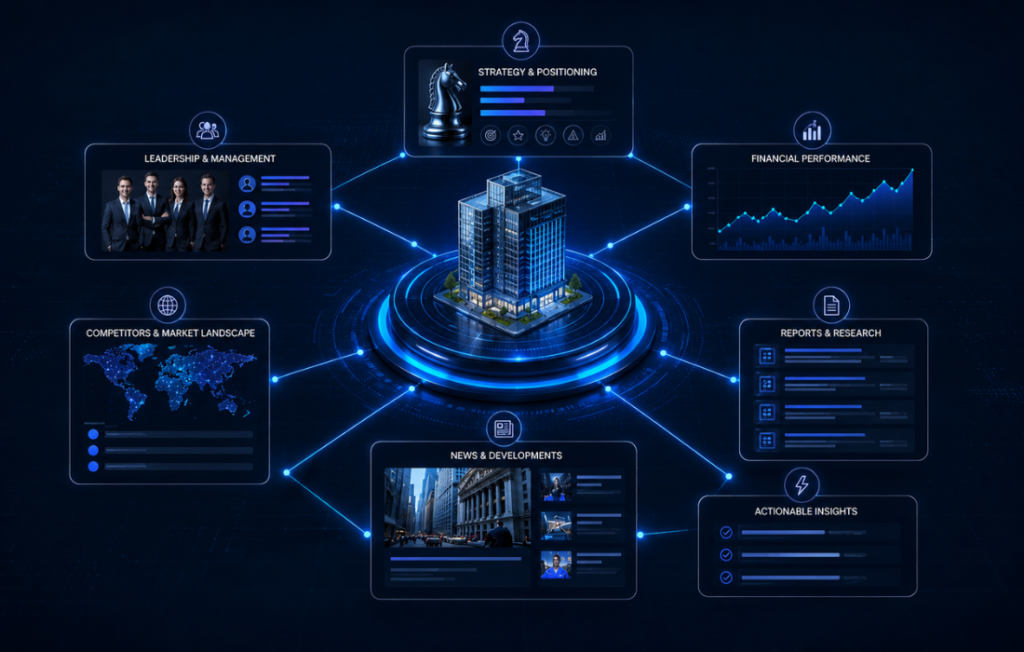
A strong dossier normally establishes the company’s identity before moving into interpretation. That means understanding its business model, principal products or services, customers, markets, leadership, ownership, competitors and relevant corporate structure. The Carnegie Mellon corporate-strategy research guide similarly identifies organizational structure, issues, news, history, financial information and company statistics as important research areas.
The next layer is change. Recent leadership appointments, product launches, acquisitions, partnerships, geographic expansion, restructuring, hiring activity, regulatory developments or strategic announcements can reveal considerably more than a static company description. The Library of Congress specifically recommends searching company news alongside product lines and competitors because these combinations can reveal how the business and its market position are being discussed.
Company identity and business model
Start by establishing what the company actually does and how it generates economic value. A useful profile should clarify its principal offerings, customer groups, geographic markets, business model, ownership context and major operating segments when reliable information is available.
Avoid simply copying the company’s positioning language. A company may describe itself as an industry leader, technology innovator or customer first platform, but those are claims rather than independent conclusions. A stronger dossier distinguishes what the company says about itself from what filings, customers, competitors, regulators, journalists or other credible sources independently indicate.
Leadership, ownership and organizational structure
Leadership research should identify the executives and organizational relationships that are relevant to the research objective. For a sales dossier, this could mean understanding the executives responsible for a particular function. For investment research, ownership, governance, subsidiaries and management changes may become substantially more important.
Organizational structure can also provide context that a simple executive list misses. A company with multiple divisions or subsidiaries may have different strategies, customers, technologies and financial characteristics across those units. Researching the structure helps prevent the common mistake of treating a complex organization as though it were a single homogeneous business.
Products, customers and markets
Product research should answer more than “what does the company sell?” It should establish who buys the offering, what problem it addresses, how it is differentiated, and which markets appear strategically important. Competitor comparisons can be particularly useful because external positioning often reveals differences that company controlled material does not emphasize.
Customer information requires similar care. Named customers, customer categories, case studies, contracts, partnerships and industry concentration can all provide useful context, but each should be evaluated according to its source and date. The absence of public customer information should not automatically be interpreted as evidence of weakness.
Financial and commercial signals
Financial research depends heavily on whether the target is public or private. Public companies can provide formal disclosures and periodic reporting, while private companies may offer substantially less financial detail. In either case, researchers should distinguish reported figures from estimates, third party databases, management statements and unsupported online claims.
The goal is not always to build a complete financial model. Sometimes the useful question is whether the company appears to be expanding, restructuring, investing, reducing costs, entering new markets or changing its commercial priorities. Those signals can help explain why a particular event matters without pretending that incomplete public data provides certainty.
Competitors and market positioning
Competitor research becomes more valuable when it is comparative rather than descriptive. Instead of creating separate profiles for several companies, examine how the target differs in product scope, customer focus, geographic reach, pricing model, technology, distribution, partnerships or strategic direction where evidence permits.
The Library of Congress recommends searching a company’s name together with major competitors because this can provide insight into how companies and the broader market view one another. This approach can expose competitive pressure, market narratives, and developments that are difficult to see from the target company’s own communications.
News, strategic initiatives, and trigger events
Recent developments deserve special attention because a company dossier can become outdated surprisingly quickly. Funding announcements, acquisitions, executive changes, new products, major contracts, regulatory actions, restructuring, litigation, geographic expansion and significant hiring can all change the interpretation of an otherwise stable company profile.
For sales teams, this is particularly important because account intelligence often incorporates trigger events and strategic initiatives before outreach. A relevant recent event can transform a generic message into a timely business conversation, provided the connection between the event and the proposed outreach is supported by evidence.
Where Should You Find Reliable Company Information?
The strongest research usually begins with primary sources because they provide information closest to the underlying event. Depending on the company, these can include regulatory filings, official corporate disclosures, investor materials, government records, formal announcements and other documents produced by accountable institutions.
Secondary sources then add context. Established news organizations, trade publications, academic research, industry associations, and reputable databases can help explain what an announcement means, how competitors are responding, or whether an apparently significant development is actually part of a broader industry trend.
Why source triangulation matters
No single source should automatically become the complete truth. A company announcement may accurately describe what management intends to accomplish but cannot independently establish that the strategy will succeed. A news article may provide valuable context but contain outdated information. A commercial database may provide useful estimates while using methodologies that are not fully visible.
Source triangulation means comparing different types of evidence before reaching an important conclusion. If multiple credible sources independently support the same fact, confidence increases. If sources disagree, the disagreement itself becomes research material and should be recorded rather than quietly resolved through guesswork.
How to Build a Research Dossier for Target Company
Start with the decision the research must support
Before opening search results, define what the dossier is supposed to accomplish. “Research this company” is too broad to produce consistently useful work. A better question is whether you are preparing for a meeting, evaluating an investment, assessing a partnership, studying a competitor, preparing for an interview or investigating a strategic opportunity.
Once the purpose is clear, research becomes easier to prioritize. A sales dossier might emphasize organizational priorities and recent trigger events, while an investment dossier may require considerably deeper financial and governance analysis. Professional company-research workflows similarly distinguish research according to the user’s objective and target role.
Establish the company baseline
The baseline should establish the facts that are unlikely to change every week. Research the company’s identity, business model, products, markets, leadership, ownership context, competitors and major organizational divisions. Record the date associated with information wherever possible because even apparently stable company facts can become outdated.
This baseline becomes the reference point for interpreting newer developments. Without it, researchers often overreact to individual announcements because they lack enough context to understand whether the announcement represents a major strategic shift or simply routine corporate activity.
Investigate recent changes
After establishing the baseline, investigate what has changed. Search recent news, corporate announcements, regulatory records, executive appointments, product developments, partnerships, acquisitions, hiring activity and other relevant signals. The purpose is not to collect every event but to identify developments that could affect the research objective.
A useful test is simple: if this event disappeared from the dossier, would the reader’s understanding of the company materially change? If the answer is no, the event probably belongs in background notes rather than the final executive summary.
Compare the company with competitors
Competitive analysis should identify meaningful differences rather than create a catalogue of rival companies. Examine the dimensions that matter to the research objective and ask whether the target appears stronger, weaker, differentiated, or exposed in each relevant area.
The comparison should remain evidence-led. Claims such as “market leader” or “most innovative company” should not be repeated merely because they appear in marketing material. If a market-position claim cannot be independently supported, present it as the company’s positioning rather than established fact.
Separate evidence from interpretation
One of the most important disciplines in a research dossier is separating what you know from what you infer. “The company announced a new regional office” is an observable claim if supported by a reliable source. “The company is preparing for rapid international expansion” is an interpretation that requires additional evidence.
Making this distinction explicit improves trust. It also allows readers to challenge an interpretation without disputing the underlying facts. A strong dossier should make clear where evidence ends and analytical judgment begins, particularly when information is incomplete or contradictory.
Turn findings into an actionable brief
The final dossier should answer the practical question that motivated the research. A sales reader should understand why the account matters and what context should shape outreach. An investor should understand the central opportunities, risks, assumptions and unanswered questions. A job seeker should understand the company’s business priorities and organizational environment.
This is where many company-research documents become unnecessarily long. More pages do not automatically mean better research. The goal is to make important evidence easier to find, important uncertainty easier to recognize and important decisions easier to make.
How to Evaluate the Quality of Your Research
Accuracy is the first standard. Every important factual statement should be traceable to a source appropriate to the claim. Recency is the second standard because leadership, strategy, products, financial circumstances and market conditions can change.
Completeness matters, but it should not be confused with volume. A dossier can contain dozens of pages and still omit the one development that changes the strategic picture. The strongest research balances breadth with relevance and makes uncertainty visible instead of hiding it behind polished prose.
Contradictions deserve particular attention. If two credible sources provide different figures or descriptions, record the discrepancy and investigate why it exists. Differences may reflect publication dates, definitions, reporting periods, corporate structures or methodological differences rather than simple error.
How Different Professionals Use a Company Dossier
Sales and business development teams can use a dossier to understand an account before outreach. Modern account research approaches commonly examine firmographics, leadership, strategic initiatives, technology signals and trigger events to replace generic prospecting with more contextual engagement.
Investors and acquisition teams use deeper research to understand the target’s market, financial position, competitive environment, technology, governance and risks. Due diligence is more rigorous than ordinary company research because the consequences of an incorrect assumption can be significantly larger. Bain’s discussion of technology diligence emphasizes connecting diligence findings to the actual investment thesis rather than producing disconnected observations.
Job seekers can use company research to understand the organization before an interview, networking conversation or application. Career research guidance commonly recommends examining the industry, products or services, customers, leadership, locations, organizational structure and recent company information.
Consultants and strategic teams can use the dossier as an evidence base for market analysis, competitive positioning, partnership assessment or strategic recommendations. In these contexts, the dossier is rarely the final product. Its purpose is to make the reasoning behind a later recommendation more informed and defensible.
Common Mistakes When Researching a Target Company
The first mistake is collecting facts without defining the decision. A dossier assembled without a purpose tends to become a storage container for interesting information. Readers then have to perform the analysis themselves, which defeats much of the reason for commissioning the research.
The second mistake is depending on one source. Company controlled information is valuable, but it represents one perspective. Independent reporting, regulatory information, industry research, customer evidence and competitive material can provide context that a company’s own communications naturally cannot.
Another mistake is confusing claims with evidence. Calling a company a “market leader” because its website says so does not establish market leadership. The same principle applies to claims about innovation, customer satisfaction, growth, technology or competitive advantage.
Ignoring recent changes is equally dangerous. A company profile written six months ago may still contain correct historical facts while providing a misleading picture of current priorities. A good dossier therefore combines a stable baseline with a deliberate review of recent developments.
Finally, researchers often overload the final document. The research process can be extensive, but the finished dossier should be selective. The reader needs the facts, evidence, implications and uncertainties that matter to the decision not every search result discovered along the way.
Conclusion
A research dossier for target company should not be treated as a longer version of a company profile. Its real value comes from combining reliable evidence with context, comparison, interpretation and clear relevance to a specific business decision.
The strongest dossier begins with a defined objective, establishes a factual baseline, investigates meaningful changes, compares the target with its competitive environment, evaluates source quality and distinguishes evidence from interpretation. That process produces something much more useful than a collection of search results a defensible intelligence brief that helps the reader decide what deserves attention next.
FAQs
What is a research dossier for target company?
A structured document containing verified information about a company, including its business, market, leadership, competitors, risks and opportunities.
How long should a company research dossier be?
Its length depends on the purpose and complexity of the company, ranging from a short sales brief to detailed due diligence.
What information should a company dossier contain?
It should cover company details, business model, products, customers, leadership, competitors, financial signals, risks and opportunities.
How do you research a private company?
Use reliable sources such as company announcements, news, industry publications, regulatory records and professional databases.
What sources are best for company research?
Primary sources are best for company facts, while credible news, government records, industry publications and databases provide additional context.
How is a dossier different from due diligence?
A dossier is a general research document, while due diligence is a deeper investigation for major business or financial decisions.
Can AI help create a company research dossier?
Yes, AI can speed up research and organization, but important information should always be verified with reliable sources.
How often should a company dossier be updated?
It should be updated when major changes occur, such as leadership, financial, product, regulatory or competitive developments.